Current-sense amp with AEC-Q100 grade — what the ratings mean for a BOM line
The INA190A1QDCKRQ1 is a single-channel current-sense amplifier from Texas Instruments, qualified to AEC-Q100 — the automotive IC reliability standard covering temperature range, ESD, and lifetime stress. That qualification places it in designs where the ambient temperature spans -40 °C to 125 °C and the supply rail is anywhere from 1.7 V to 5.5 V, covering common 3.3 V and 5 V automotive buses without a secondary regulator. Its 45 kHz gain-bandwidth product sets the usable bandwidth for the shunt-voltage measurement — above that frequency the gain rolls off, so the output settling time for a fast load transient is limited by the amplifier's slew rate of 0.3 V/µs, not the shunt RC time constant. For DC or low-frequency current monitoring, the 3 µV typical input offset voltage dominates the error budget at low shunt drops; the 500 pA input bias current is negligible unless the shunt resistance exceeds 10 kΩ.
Active lifecycle — no end-of-life watch needed
Texas Instruments lists the INA190A1QDCKRQ1 as Active with ROHS3 compliance. Sourced through independent distribution; availability and current pricing are confirmed at RFQ.
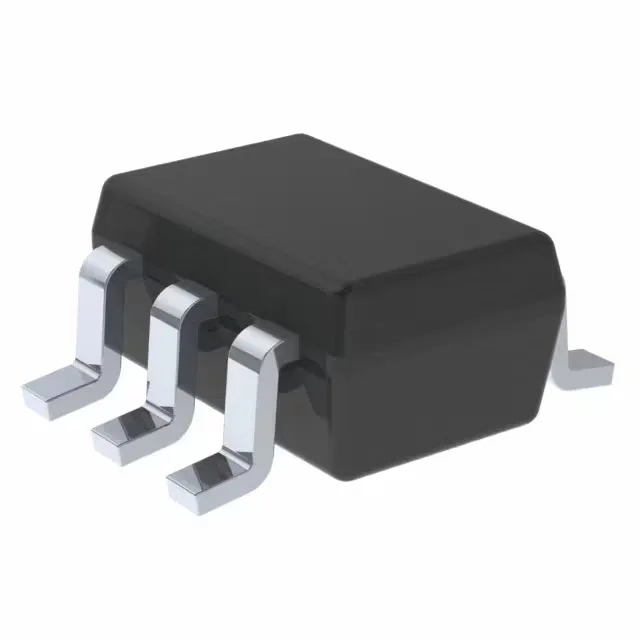
SC-70-6 package — footprint and thermal reality
The part ships in a 6-pin SC-70-6 (SOT-363) package, with the supplier device package designated SC-70-6. Surface-mount only. The 48 µA supply current keeps self-heating negligible — the package's thermal impedance is not the limiting factor in any realistic layout. The rail-to-rail output swings within millivolts of the supply rails, preserving the full dynamic range of the downstream ADC input.