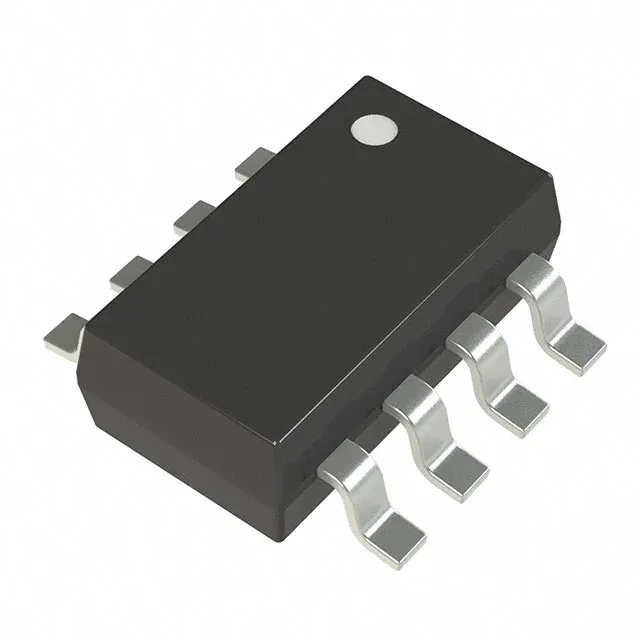
45 kHz bandwidth, 3 µV offset — precision current sensing in a TSOT-23-8
The INA186A1IDDFT is a single-channel, zero-drift current-sense amplifier from Texas Instruments. It measures the voltage across a shunt resistor and outputs a ground-referenced, rail-to-rail signal proportional to the load current. Housed in a TSOT-23-8 package, it operates from a 1.7 V to 5.5 V supply span and draws just 48 µA quiescent current — low enough for always-on monitoring in battery-powered systems. The 45 kHz gain-bandwidth product sets the usable signal bandwidth for the shunt voltage measurement — above this frequency the amplifier's gain rolls off, so the shunt RC filter corner should be placed below 45 kHz to avoid attenuating the signal.
Zero-drift architecture and input precision
The zero-drift topology holds the input offset voltage to 3 µV typical, with an input bias current of 500 pA. This means the measurement error from the amplifier itself stays below a few microvolts across temperature — critical for sensing millivolt-level drops across a sub-milliohm shunt. The 0.3 V/µs slew rate limits the large-signal response time, but for DC and low-frequency current monitoring (motor windings, solenoid hold currents, battery charge/discharge) it is more than adequate — the bandwidth is the limiting factor, not the slew rate. Rail-to-rail output swing lets the amplifier use the full ADC input range without a level-shifter — the output can swing within tens of millivolts of both supply rails, preserving dynamic range in a 3.3 V or 5 V system.
Active production, ROHS3, and -40°C to 125°C range
The part is available through authorized and independent distribution channels — quoted to order against the BOM quantity.