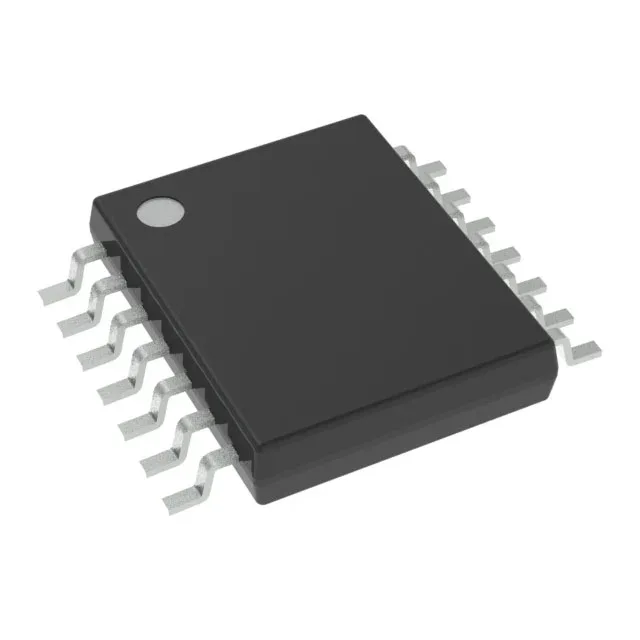
Quad bilateral switch for analog and digital signal routing
Each of the four independent switches can pass analog or digital signals up to the full supply rail, with a typical on-state resistance of 240Ohm max and channel-to-channel matching of 5Ohm. The wide single-supply range of 3V to 18V lets it interface directly with 5V logic or higher-voltage analog signals without level shifting. The 40MHz -3dB bandwidth supports switching of composite video, audio, and moderate-speed digital data lines.
240Ohm on-resistance — what it means for signal integrity
The 240Ohm max on-resistance (Ron) is the series resistance the signal sees through the switch. In a 5V system switching a 10kOhm load, the voltage drop across Ron is about 24mV — negligible for logic levels but a factor if you are routing a precision analog reference or a low-impedance audio line. The 5Ohm channel-to-channel matching (Delta Ron) keeps the attenuation consistent across all four switches, which matters for stereo audio or multi-channel sensor muxing where gain matching is needed.
Supply flexibility and signal range
With a single-supply range of 3V to 18V, the CD4066BPW can be powered from a 5V rail for TTL/CMOS logic switching, or from a 12V or 15V rail for industrial analog signals. The bilateral nature means it conducts equally well in both directions, so it can be used as a multiplexer, demultiplexer, or signal gate. The 8pF channel capacitance (CS(off), CD(off)) keeps the off-state isolation reasonable at lower frequencies, though at 40MHz bandwidth you will see some feedthrough.
For a 4000B-series part that has been in production for decades, this is a stable BOM line for new and sustaining designs.