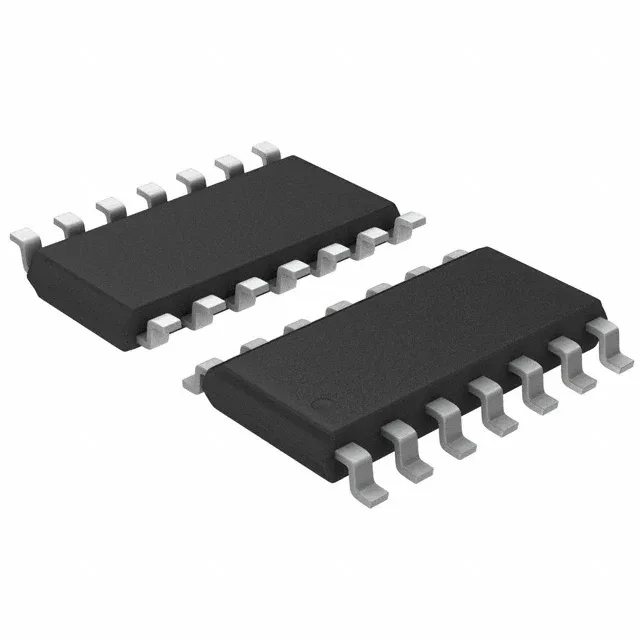
Quad bilateral switch for analog and digital signal routing
The CD4066BNS is a quad bilateral switch from the 4000B series, configured as four independent SPST 1:1 switches in a single 14-SOIC package. Each switch passes analog or digital signals up to the full supply rail with a typical on-resistance of 240 Ohm and channel-to-channel matching of 5 Ohm. The supply range spans 3 V to 18 V single supply, and the device operates across the full military temperature range of -55°C to 125°C, making it suitable for industrial and harsh-environment boards.
Bandwidth and capacitance — what limits the signal path
The -3 dB bandwidth is 40 MHz, which sets the upper frequency for low-attenuation analog switching. Above this frequency the insertion loss rises, so for video or RF paths the switch acts as a low-pass filter. Channel off-capacitance is 8 pF typical (CS(off), CD(off)). This capacitance loads the signal line when the switch is open, contributing to crosstalk at higher frequencies and increasing the settling time in multiplexed ADC front-ends.