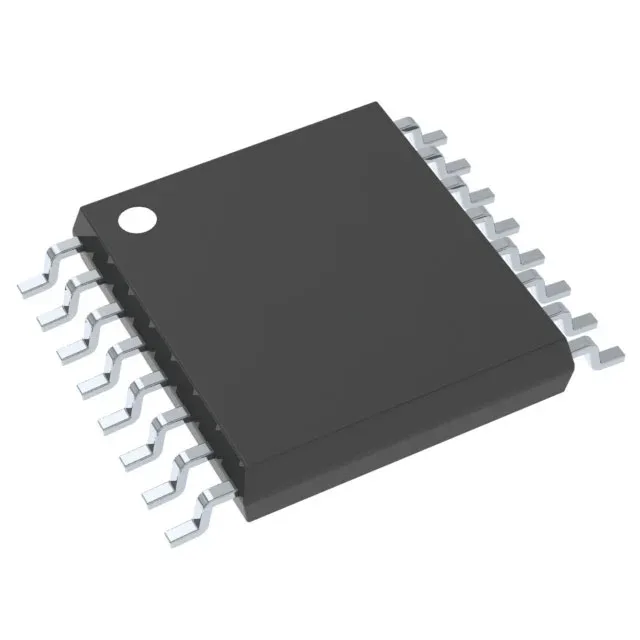
The Texas Instruments CD4053BPWRE4 is a triple single-pole double-throw (SPDT) analog multiplexer/demultiplexer, part of the CD4053B family. Each of the three independent switches routes a common input to one of two outputs (2:1 mux/demux), controlled by a digital select line. Key parametrics for signal-integrity budgeting: the -3 dB bandwidth is 30 MHz, crosstalk between channels is -40 dB at 6 MHz, and the maximum on-state resistance is 240 Ohm. The channel-to-channel on-resistance matching is 5 Ohm, which matters when the switch is used in gain-setting or attenuator networks where the resistance delta directly affects ratio accuracy.
The 16-TSSOP package body is 0.173 inches wide and 4.40 mm long, with a 0.65 mm lead pitch — a standard surface-mount footprint that matches the CD4053B family layout across package variants.
Supply rails and leakage — design-in checklist
The CD4053BPWRE4 operates from a single supply of 3 V to 20 V, or from dual supplies of ±2.5 V to ±9 V. The dual-supply capability allows the switch to handle bipolar analog signals without external level-shifting, which is useful in audio and instrumentation front-ends where the signal swings below ground. Maximum off-state leakage current is 100 nA per channel, and the off-state capacitance is 0.2 pF on the switch side and 9 pF on the common side. These leakage and capacitance figures set the floor for signal attenuation and settling time in high-impedance or high-frequency paths — the 9 pF common-node capacitance will dominate the RC time constant in a 50-Ohm system.