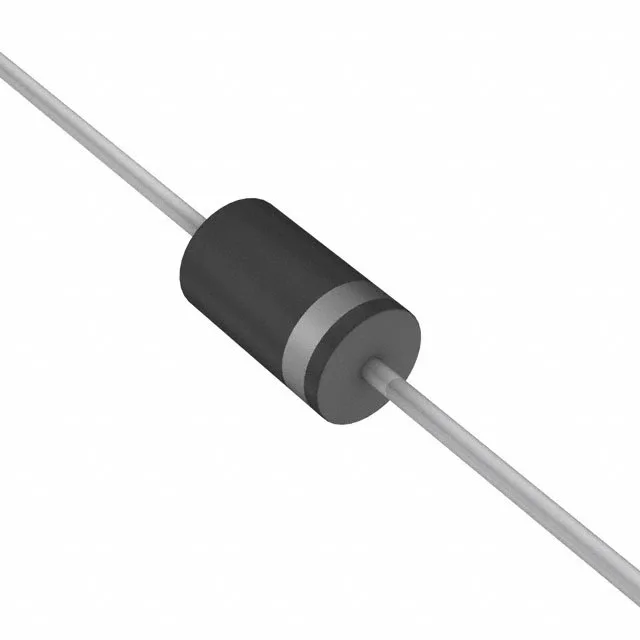
Protection window for a 75 V bus
The 1.5KE75CAHA0G: Its breakdown triggers at 71.3 V minimum, and the clamping voltage peaks at 103 V when the 10/1000 µs surge current reaches 15 A. For a 75 V nominal DC bus — common in automotive 48 V systems after a boost stage, or in industrial 72 V battery banks — the 64.1 V standoff holds the leakage below the rail during normal operation, while the 103 V clamp keeps the voltage spike within the safe operating area of downstream FETs and ICs rated for 120 V or higher. The 1500 W peak pulse rating (1.5 kW into a 10/1000 µs waveform) means this single device absorbs the energy of a typical load-dump or inductive kick without needing a parallel suppressor — a clean one-device-per-bus solution.
Qualified to AEC-Q101, the automotive stress-test standard for discrete semiconductors. This covers the temperature cycling, high-temperature reverse bias, and ESD robustness required for under-hood and chassis-mounted electronics — an engine ECU, transmission controller, or battery-management sensor interface sees this grade of transient protection. At 175°C junction, the leakage current rises but the clamping voltage stays within the datasheet limit — the 103 V clamp is specified at the peak pulse condition. No power-line protection (the device is a standalone transient suppressor, not a filtered TVS array) — it clamps the differential surge across the two leads, not a common-mode or RF-filtered event. The bidirectional channel handles symmetrical clamping for AC-coupled or floating bus lines.
Package and board integration
Supplied in the DO-201AA (DO-27) axial-lead package, through-hole mounted. The 0.052-inch lead diameter and 0.375-inch body length fit standard 1.0 mm diameter plated-through holes on a 2.54 mm pitch grid. The axial leads allow vertical or horizontal mounting — useful for dense PCB layouts where a surface-mount SOD-123 or SMB would consume board area. The Tape & Box (TB) packaging option suits pick-and-place for through-hole insertion equipment, though the axial format typically requires a radial-tape conversion or manual insertion. For high-volume automotive lines, the TB format keeps the leads aligned for automated clinching. The base product number 1.5KE75 identifies the voltage family; the CAHA0G suffix encodes the bidirectional channel (CA), the AEC-Q101 automotive grade (H), and the packaging code. A unidirectional variant (1.5KE75AHA0G) exists for DC-only bus protection where reverse polarity is not a concern.