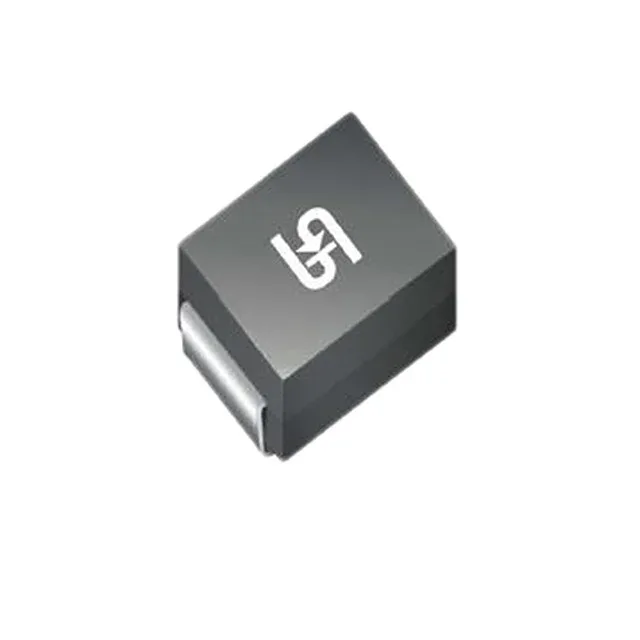
What this part is
The 5.0SMDJ43AHM6G is a unidirectional Zener-based TVS (transient voltage suppressor) in the 5.0SMDJ series, AEC-Q101 qualified for automotive environments. At 43 V reverse standoff (typ) it sits above the nominal rail it protects, so normal 12 V and 24 V automotive supply lines stay within the suppressor leakage band until a surge arrives. The clamping ceiling is 69.4 V max at a 72.1 A peak pulse (10/1000 µs), which is the rating that matters for load-dump and inductive kick profiles in the vehicle electrical domain.
5 kW peak pulse — what that means for the protection window
The 5000 W peak pulse rating (5 kW at 10/1000 µs) defines the energy the device can absorb during a single transient event without degradation. The 47.8 V minimum breakdown and 69.4 V maximum clamping level bound the protection window — any overvoltage above ~48 V clamps hard to keep the downstream IC within its abs-max rating.
DO-214AB package and SMT assembly
Tape-and-reel packaging with cut-tape option supports both high-volume SMT placement and low-quantity prototype builds. Junction temperature limit of 175 °C gives plenty of headroom above typical under-hood ambient peaks, but the clamping energy per event still drives the board-level thermal design.
Automotive grade and qualification
AEC-Q101 is the automotive discrete semiconductor stress qualification — it validates the part against temperature cycling, humidity bias, HTRB (high-temperature reverse bias), and surge-life testing at a level that exceeds commercial grade. The -55 °C to 175 °C junction temperature range maps to the under-hood cold-start to full-load band, and the 175 °C ceiling is a meaningful step above the 150 °C ceiling common on commercial TVS parts. If the board runs in a chassis-domain location without active cooling, that temperature grade is the deciding selection criterion.
As a single-sourced branded part from one manufacturer, any BOM that pins to this exact order code should carry a cross-reference search in the 5.0SMDJ family at the same standoff and peak-pulse rating before committing to a long-term build.