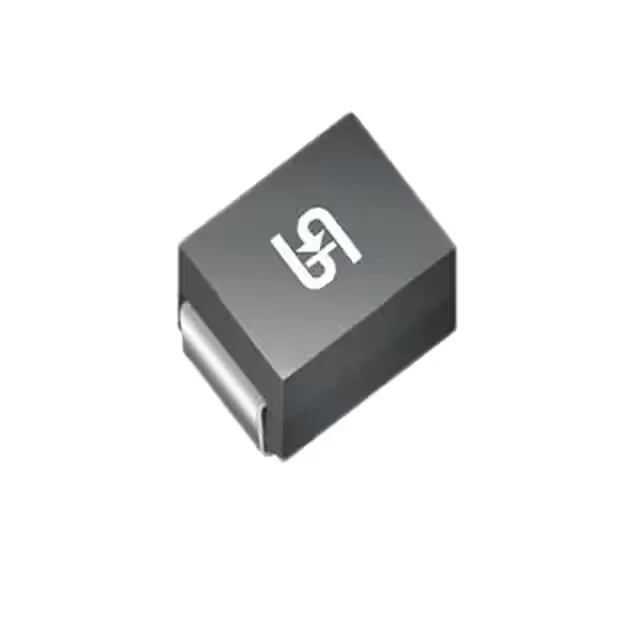
Transient protection in a unidirectional Zener TVS
The 5.0SMDJ45AHM6G is an AEC-Q101-qualified unidirectional Zener TVS in the DO-214AB (SMC) package — the standard avalanche-rated surface-mount footprint for automotive 5 kW bidirectional-transient suppression.
Voltage ratings — what the three numbers mean
A 45 V reverse standoff keeps the device off during normal 12 V and 24 V automotive rail operation. Once a surge drives the line above the 50 V minimum breakdown, the avalanche clamps — the maximum clamping voltage at peak pulse current is 72.7 V. That 27.7 V overdrive above standoff is the clamping headroom that absorbs the transient energy before the downstream circuitry sees it. The part is listed as unidirectional — it handles one polarity of surge. For bidirectional protection (AC rails, inductive kick-off on both polarities), a bidirectional TVS in the same series would be required; the 5.0SMDJ45AHM6G alone does not cover that case.
Surge and thermal performance
The 68.8 A is the current the clamping action conducts — the clamped voltage at that current is 72.7 V. Matching the part's peak-pulse current rating to the worst-case surge amplitude of the target system is the primary selection check before anything else. In an engine-compartment or chassis-mount application, the board thermal design must keep the case-to-ambient thermal resistance low enough that the actual Tj stays below 175°C under worst-case load and ambient conditions.
Automotive qualification and deployment context
AEC-Q101 is the automotive stress-test qualification for discrete semiconductors — it screens for temperature cycling, high-temperature reverse bias, humidity, and mechanical shock endurance to levels appropriate for the engine bay and chassis domain. The 5.0SMDJ45AHM6G is classified for automotive applications specifically — this is the rating that gates it into under-hood and body-control-module BOMs where AEC qualification is a procurement prerequisite.