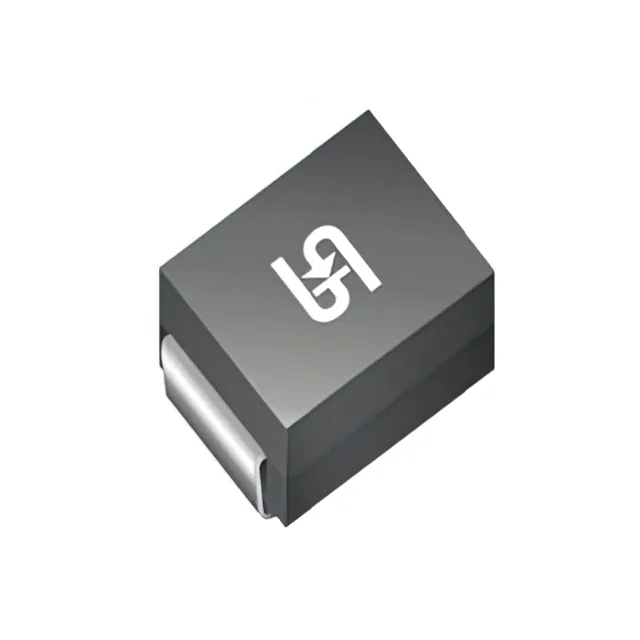
Clamping and standoff: what 18 V / 29.2 V means for the protection boundary
The 5.0SMDJ18AH: The reverse standoff of 18 V sets the continuous working voltage the diode can block without conduction — the clamping action fires only when a transient pushes the line above that threshold. The gap between 18 V standoff and 29.2 V clamping is the let-through margin the downstream circuit must survive. It is unidirectional — it clamps positive transients only. For bidirectional protection in AC rails a different topology is needed.
AEC-Q101 in a DO-214AB SMC — automotive board-level protection fit
AEC-Q101 qualification means this TVS passed the automotive stress suite:ESD (IEC 61000-4-2), surge surge current cycling, and humidity bias — the tests that separate automotive-grade from commercial TVS in the same SMC footprint. The -55 to +175 °C junction temperature range covers the under-hood ambient band — an ECU mounted near the engine block that sees 150 °C ambient still has thermal headroom before the junction limit is reached. Power line protection is listed as No — this part protects individual signal or low-current power nodes, not bus rails, so it sits at the point-of-load on the board rather than at the main power input.