AEC-Q101 qualification — what it means for your BOM
The 1.5KE68AHA0G carries AEC-Q101 qualification, the automotive discrete semiconductor stress-test standard that covers temperature cycling, ESD sensitivity, and high-temperature reverse bias. This is the variant an OEM auditor expects to see in a PPAP submission — the base 1.5KE68A without the 'H' suffix lacks this certification. Rated for continuous junction operation from -55°C to 175°C, the device sits comfortably in the under-hood temperature band where ambient soaks above 105°C are routine. The 175°C TJ(max) ceiling gives margin above the 150°C typical for engine-bay electronics.
1500W peak pulse — clamping in the 12V/24V automotive bus
At 58.1V reverse standoff, this diode stays transparent on a nominal 12V or 24V bus — the leakage current below the breakdown knee is negligible. When a load-dump or inductive kick drives the line above 64.6V (the minimum breakdown voltage), the device clamps at 92V maximum while shunting 17A of peak pulse current in the 10/1000µs waveform.
The 'A' in the part number denotes the 5% tolerance variant (the breakdown voltage is specified as 64.6V min, 71.4V max). The 'H' suffix is the AEC-Q101 designation, and 'A0G' indicates the Tape & Box (TB) packaging format.
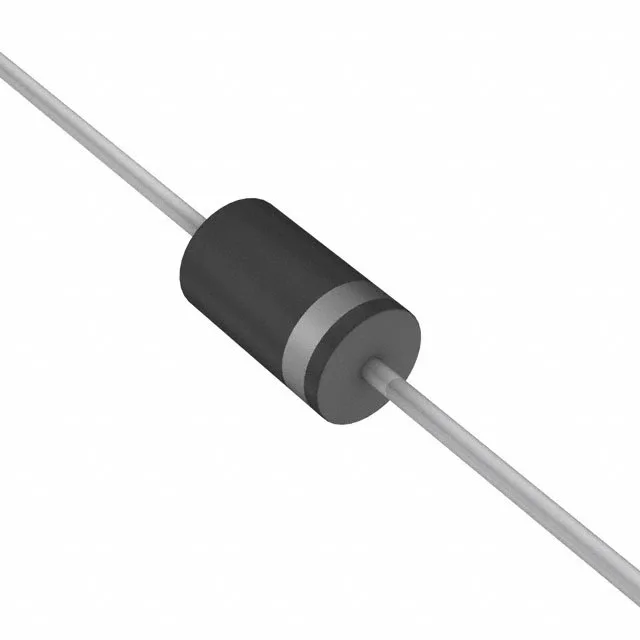
DO-201 axial package — board integration notes
The DO-201AA (also known as DO-27) is a through-hole axial package with a body diameter of approximately 5.3 mm and lead diameter of 1.0 mm. The cathode band is marked on the body; the leads are tin-plated copper for solderability.