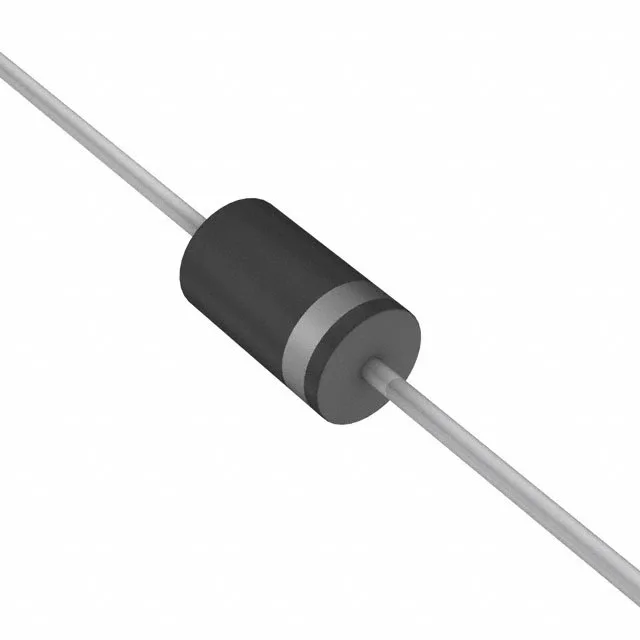
Parametric fit for 48V bus protection
The 1.5KE56CAHB0G: The 47.8V reverse standoff is the working voltage — a 48V nominal DC bus (like an automotive 48V mild-hybrid rail or a telecom -48V supply) sits below this threshold, so the TVS draws negligible leakage in normal operation. Breakdown triggers at 53.2V minimum, giving a 5.4V guard band before the device starts conducting. Clamping at 77V means the protected circuit sees no more than 77V across the terminals during a 20A surge. For a downstream DC-DC converter rated at 80V abs-max, this 3V margin is tight — verify the converter's avalanche rating and input capacitance, which absorbs part of the surge energy before the TVS clamps. The DO-201 axial package is a through-hole leaded form factor. The 0.042-inch diameter leads solder into plated through-holes on a standard PCB; the body length is about 9.1 mm. Bulk packaging means loose tubes or trays — no tape-and-reel, so hand-placement or tube-fed insertion is the assembly method.
Sourcing and lifecycle posture
Active lifecycle status — Taiwan Semiconductor still produces this part. The 1.5KE series is a standard JEDEC-registered TVS family with multiple second-source suppliers (Littlefuse, Vishay, ON Semiconductor all make 1.5KE56CA equivalents). The AEC-Q101 qualification narrows the cross-reference field to automotive-grade variants only — verify the suffix (HB0G is TSC's automotive code) when substituting.