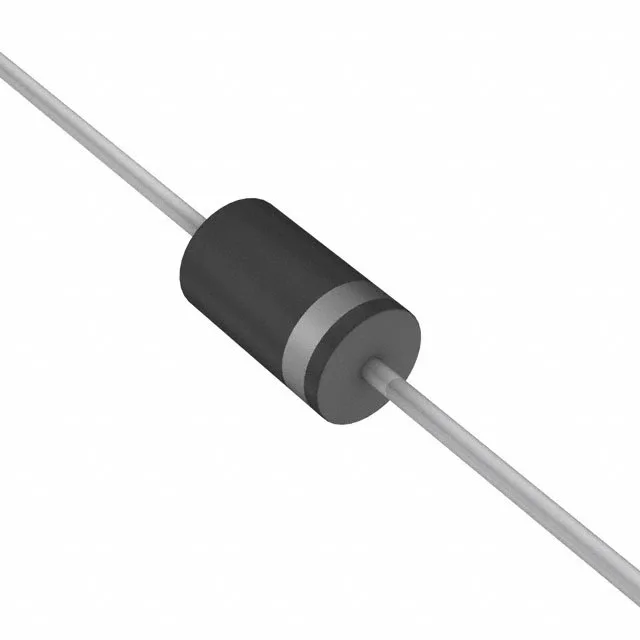
Automotive-grade transient suppressor for 40V rail clamping
The 1.5KE47CAHB0G: Its 40.2V reverse standoff voltage and 44.7V minimum breakdown voltage place it squarely on 36V to 40V nominal DC rails — common in 48V automotive systems, industrial bus supplies, and battery-backed power lines where transients from load dump or inductive kickback must be clamped before they reach downstream silicon.
Clamping parameters and what they mean for circuit protection
Maximum clamping voltage is 64.8V at the rated 24A peak pulse current. This is the voltage the TVS forces the transient down to — a 40V nominal rail seeing a 100V surge gets clamped to 64.8V, which is below the typical 80V abs-max of common 40V-rated DC-DC converters and linear regulators. The 24A peak pulse current is the maximum the device can handle in the 10/1000µs test waveform without exceeding its 1500W power rating. The single-channel layout keeps the PCB footprint to two axial leads; the DO-201AA body is the standard through-hole package for this power class, and the lead spacing matches common 0.3-inch pitch layouts.
Active production and sourcing posture
The bulk package means parts ship loose in anti-static tubes or bags — no reel or tape for automated pick-and-place, consistent with the through-hole form factor. For high-volume builds, verify the lead-forming requirements match your wave-solder or selective-solder process.