Why the AEC-Q101 grade matters for this TVS
The 1.5KE400CAHA0G carries AEC-Q101 qualification, which is the automotive discrete semiconductor stress test standard — this means the part has passed 1000-hour high-temperature reverse bias (HTRB), temperature cycling, and ESD screening at the wafer level. For an ECU designer, that qualification is the difference between a part that survives 15 years of underhood thermal cycles and one that drifts off-spec at the third summer.
Clamping voltage and the protection window
The reverse standoff voltage of 342V means it sits transparent on a 300-340V DC bus and only starts conducting when a transient pushes past that level — no leakage penalty during normal operation. The single bidirectional channel handles both positive and negative transients in one package, which saves board space on AC-coupled lines or bipolar power rails. No polarity worries during assembly — the two leads are interchangeable. The 175°C ceiling is the same temperature grade required by AEC-Q101 Grade 0 applications.
Package and board integration
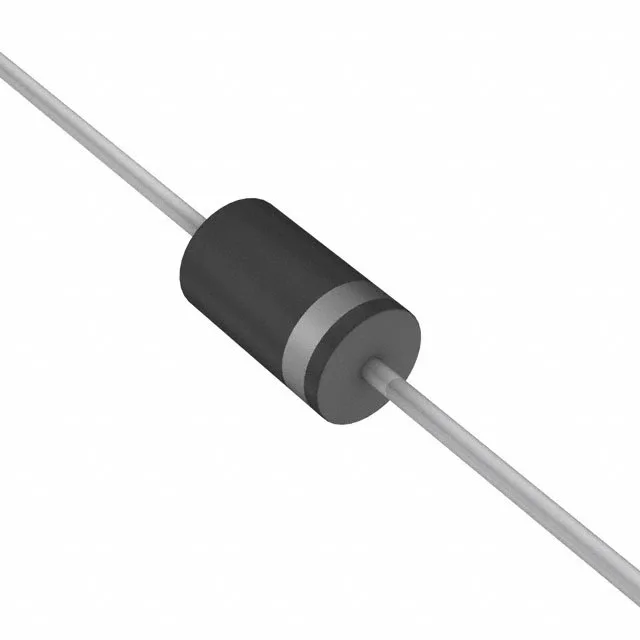
Housed in the DO-201AA (DO-27) axial-lead through-hole package, the 1.5KE400CAHA0G mates with standard 0.040-inch diameter holes on a 0.300-inch lead spacing. The axial body allows either vertical or horizontal mounting, which is useful when board height is constrained in a junction box or ECU housing. Supplied in Tape & Box (TB) format, the parts are body-taped for automatic insertion equipment — the box construction prevents the axial leads from tangling during transit.
This removes the single-source risk that often accompanies automotive-qualified parts in older package styles. The base product number 1.5KE400 covers a family of voltage variants in the same 1500W platform, so if a different standoff voltage is needed for a BOM revision, the package and qualification remain consistent.