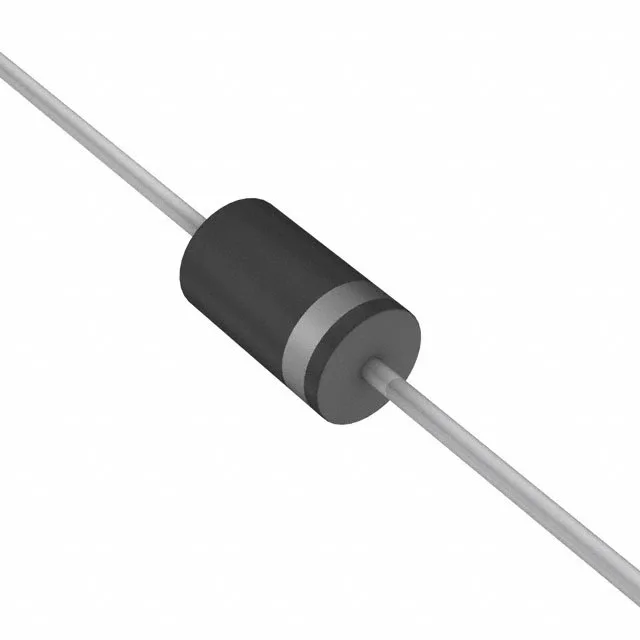
The 1.5KE350AHB0G: AEC-Q101 qualification means the device passed the full automotive stress battery: high-temperature reverse bias, temperature cycling, and ESD robustness per the JEDEC automotive discrete standard. That certification is the difference between a part that lives in an engine bay and one that fails after a few heat cycles.
Clamping voltage and pulse current — the real protection numbers
At 3.2 A peak pulse current (10/1000 µs waveform), the clamping voltage is 482 V max. In real-world transients shorter than 10 µs, the device absorbs more energy; in longer surges, derate accordingly. The 333 V minimum breakdown voltage guarantees the avalanche starts before the clamping event.
Through-hole DO-201 — board-fit realities
The DO-201AA (DO-27) axial package is a through-hole part with a 0.042-inch lead diameter typical. The hole size on the PCB should be 0.052 to 0.057 inches for a solid solder fillet — oversize the hole and the joint cracks under vibration; undersize and the lead jams before seating fully. The cathode band is marked on the body; orientation matters because this is a unidirectional device. That 175°C ceiling is the die temperature, not the ambient — in a 125°C under-hood ambient, the self-heating from a 1.5 kW pulse adds maybe 30°C, leaving 20°C margin before the junction limit. If the board sits near an exhaust manifold, derate the peak pulse power or move the TVS to a cooler spot.
Sourcing posture for this active automotive TVS
The 1.5KE350AHB0G is a single-source part from Taiwan Semiconductor. If a second-source is needed for supply security, a parametric search across the 1.5 kW, 300 V standoff class is the next step — but the AEC-Q101 grade narrows the field significantly.