What does a 30 V common-anode Zener array actually do on your board?
The UMZ30NT106 is a dual Zener diode in a common-anode configuration — both cathodes are tied together internally, with each anode brought out separately. This means you clamp two independent signal lines to the same reference rail, or use the pair as a bidirectional limiter between two rails. The 30 V nominal breakdown (Vz) sets the voltage at which the diode starts conducting in reverse; below that, it blocks with only 100 nA leakage at 23 V, so it won't load a high-impedance ADC input or a slow serial bus. The ±2.5% tolerance on Vz is tighter than the common ±5% grade — useful if your clamping threshold needs to stay within 0.75 V of 30 V across temperature and lot variation. At 200 mW maximum power, the continuous current through each diode at 30 V is limited to about 6.7 mA; brief transients can exceed that, but sustained overvoltage will exceed the die's thermal capacity.
Package and board-fit — SC-70 / SOT-323 (UMD3)
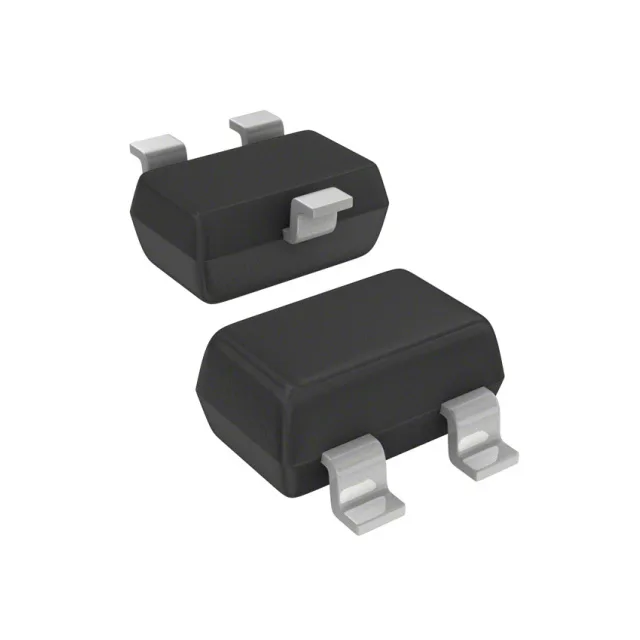
Housed in a 3-pin SC-70 (also called SOT-323) package, designated UMD3 by ROHM. The footprint is roughly 2.0 × 2.1 mm with a 0.65 mm pin pitch — small enough for dense mixed-signal boards but still hand-solderable with a fine tip. The common anode is on pin 2; the two cathodes are pins 1 and 3. Surface-mount assembly with standard reflow profiles; no exposed pad to worry about. Operating junction temperature is rated to 150 °C, so the part can sit near a warm regulator or on a multilayer board without derating. The 200 mW power limit is the practical constraint in a small package — the thermal resistance of SC-70 is around 300–400 °C/W, meaning a 200 mW dissipation raises the junction about 60–80 °C above ambient.