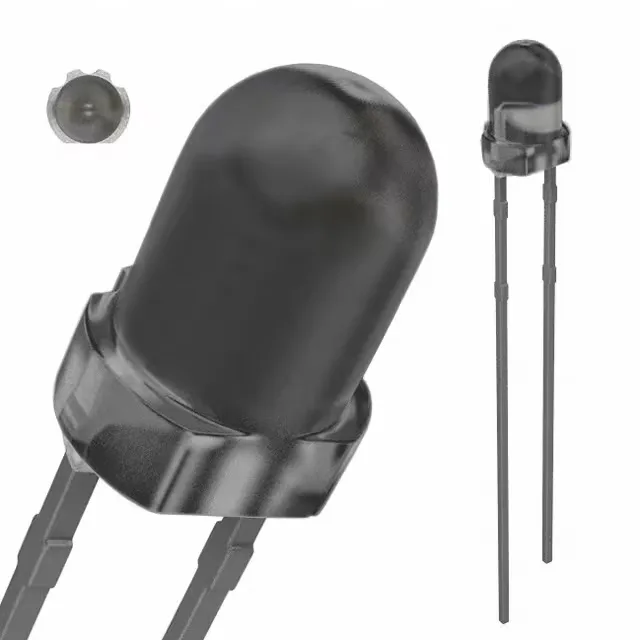
Device identity and optical fit
The RPT-37PB3FN is a silicon NPN phototransistor from ROHM Semiconductor, peaked at 800 nm — the near-infrared region where standard IR LEDs (e.g., 850 nm or 940 nm emitters) still deliver usable responsivity, though the match is tighter with an 800 nm source. Its 72° viewing angle means the detector collects light over a wide cone — useful for diffuse-reflective or proximity sensing where the emitter and receiver are not collimated, but less suited for a narrow-beam break-beam pair where a 10-20° detector would reject off-axis ambient. Top-view orientation and the T1-3/4 through-hole package place the die facing upward from the board — the lens dome protrudes above the PCB, so the mounting hole and standoff height must clear any nearby components or enclosure wall.
Rated for a collector-emitter voltage of 32 V and a switching current of 30 mA — this is the maximum the phototransistor can handle in the on-state. A typical bias resistor from collector to supply should limit the current to well below 30 mA at the expected irradiance; otherwise the device saturates or the junction overheats. Power dissipation is capped at 0.15 W. At 30 mA switching current, the Vce(sat) drop must stay under 5 V to stay within the power budget — a design that pulls 30 mA at 24 V supply through the phototransistor would exceed the dissipation limit unless the collector resistor drops most of the voltage. The operating temperature range is -25°C to 85°C — industrial grade, not extended automotive. Below -25°C the photocurrent gain drops; above 85°C the dark current rises and the signal-to-noise ratio degrades, especially in low-light detection.
No pin-compatible second-source or successor is documented by ROHM; the part is sole-sourced to the RPT-37 family.