Active production — what it means for the BOM line
The RB238NS-30TL: For a BOM that already qualifies this part, the supply risk is the standard semiconductor availability window, not an obsolescence-driven scramble.
40 A per diode — conduction loss and the forward-drop trade
Each Schottky in the common-cathode pair is rated for 40 A average rectified current. At that 40 A level the forward drop is not specified directly, but at 20 A the Vf max is 750 mV — so at full rated current the drop will be higher, and the conduction loss scales accordingly. The 30 V reverse voltage is the working ceiling. Reverse leakage is spec'd at 12 µA typical at that 30 V — ROHM markets this as 'super low IR', which matters in OR-ing and battery-backup circuits where leakage current drains the reserve when the diode is reverse-biased.
Common-cathode pair — OR-ing and redundant supply topology
Two Schottkys sharing a cathode in one TO-263S package is the textbook topology for diode-OR power supplies: each anode connects to a separate input rail (e.g., main PSU and battery backup), and the common cathode feeds the load. The shared cathode tab simplifies the PCB layout — one large copper pour handles the combined output current, and the two anodes route to their respective supplies. The fast recovery classification (≤ 500 ns) is inherent to the Schottky barrier — there is no stored charge to sweep out, so switching losses are negligible compared to a PN-junction recovery diode. The speed limit here is the package inductance and the board layout, not the die itself.
Package and board-fit — TO-263S LPDS
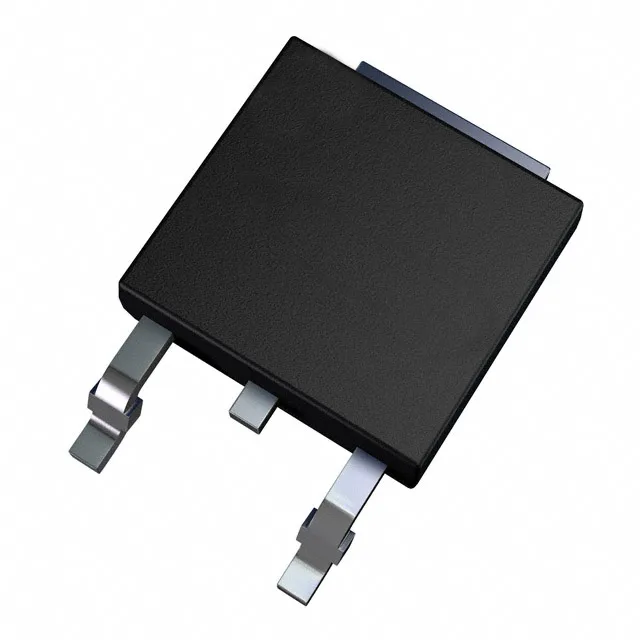
The TO-263-3 (D²Pak) footprint is standard for high-current surface-mount diodes.