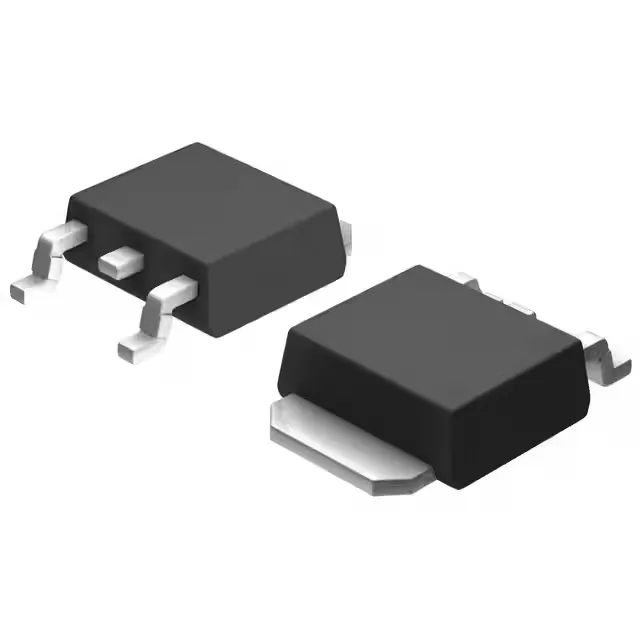
Package and board-fit for the BD3650FP-ME2
The exposed tab is the ground path and the primary thermal interface — the copper area under the tab on the PCB sets the junction-to-ambient thermal resistance. Mounting is surface-mount; the tab is soldered to the board pad, not bolted. The DPak footprint is standard — the same land pattern used for many power MOSFETs and regulators in this class, so the board layout is straightforward if the copper pour under the tab is sized for the dissipation.
What the 60 dB PSRR means for your rail
The 60 dB PSRR at 120 Hz means the regulator attenuates 120 Hz ripple (full-wave rectifier residue) by a factor of 1000. If the input has 100 mVpp of 120 Hz ripple, the output sees roughly 0.1 mVpp — clean enough for most analog front-ends and sensor supplies. At higher frequencies the PSRR rolls off, so upstream switching noise above a few kilohertz needs its own filter ahead of the LDO. The protection features — over-current and over-temperature — are built in. The over-current limit folds back the output current under a short, and the thermal shutdown trips when the die exceeds the safe junction temperature. These are not adjustable; they are there to keep the part from failing catastrophically under a fault.
Active lifecycle and compliance documentation
The supply current is 1 mA maximum — the quiescent draw is low enough for always-on rails in battery-backed systems. The 30 V maximum input voltage gives headroom for 24 V industrial rails and 12 V automotive systems with load-dump transients, as long as the transient stays below the abs-max.