What the 32 MHz core and 128 KB Flash mean for the BOM
The Renesas R5F51115ADNE#2A is a 32-bit RX111 MCU clocked at 32 MHz, with 128 KB of Flash program memory and 16 KB of RAM. That memory split is sized for a single control-loop firmware image with room for a modest bootloader and a data-logging buffer — think sensor fusion in an industrial transmitter or a brushless-DC motor controller that needs to store calibration tables. The integrated 8 KB EEPROM eliminates a separate serial EEPROM from the BOM, saving board area and a supply line. The 32 MHz clock is enough to run a PID loop at several kilohertz or handle USB full-speed packet processing without a dedicated USB controller. The peripheral set — DMA, LVD, POR, PWM, WDT — covers the usual housekeeping for an industrial design: brown-out detection, watchdog, and PWM outputs for motor or LED drive. Connectivity includes I²C, SCI (UART), SPI, and USB, so this part can serve as a system controller talking to sensors over I²C and reporting results over USB or UART.
Package and thermal: 48-HWQFN with exposed pad
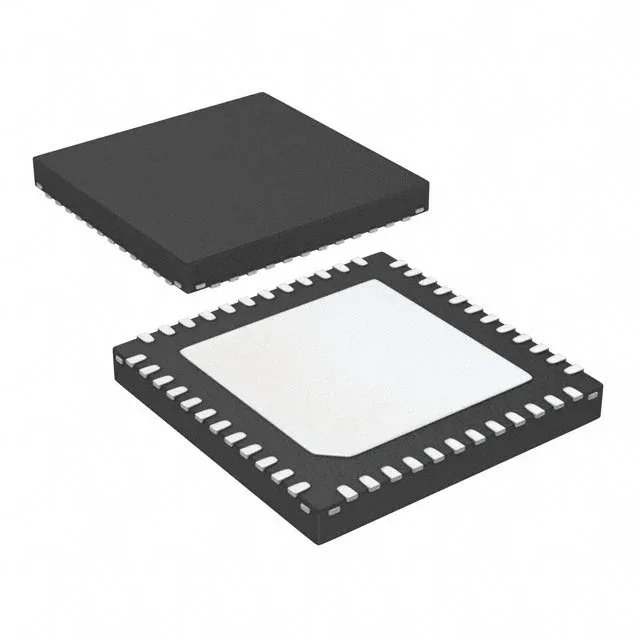
The R5F51115ADNE#2A comes in a 48-WFQFN with an exposed pad (supplier device package 48-HWQFN, 7x7 mm). The pad also serves as the ground return for the core; a solid via array to the ground plane keeps both thermal and electrical impedance low.
It fits factory-floor automation, outdoor telecom cabinets, and engine-bay-adjacent electronics that see moderate heat but not the full 125°C automotive under-hood range. The 1.8 V to 3.6 V supply range lets it run from a single Li-ion cell or a 3.3 V rail, and the internal oscillator eliminates an external crystal for applications that can tolerate ±2% accuracy over temperature.