Active production — no last-time-buy scramble needed
The R5F10269GSM#35: ROHS3 compliant per the manufacturer's declaration, so it ships into EU, UKCA, and other restricted-substance jurisdictions without exemption paperwork.
24 MHz RL78 core with 12 KB flash — what the memory budget buys
The 16-bit RL78 core runs at 24 MHz — enough throughput for a sensor hub polling 11 ADC channels at 10-bit resolution while managing a UART or I²C link to a host controller. The 12 KB on-chip flash (12K x 8) holds a modest application stack plus the HAL; the 2 KB EEPROM (2K x 8) stores calibration constants or configuration parameters without wearing the flash. 1 KB RAM (1K x 8) is the tight spot — budget it for the stack, a few ring buffers, and the ADC result array. A firmware engineer targeting this part should plan for register-based variables and lean interrupt handlers.
Supply range and temperature grade — where it lives on the board
The wide range also covers battery-discharge scenarios — a 2-cell alkaline pack down to 1.8 V still keeps the core alive. Industrial temperature grade: -40°C to 105°C ambient. That puts it in the engine-bay, rooftop solar combiner box, or outdoor pump controller class — not just climate-controlled indoor panels.
20-LSSOP footprint and I/O count — board-fit constraints
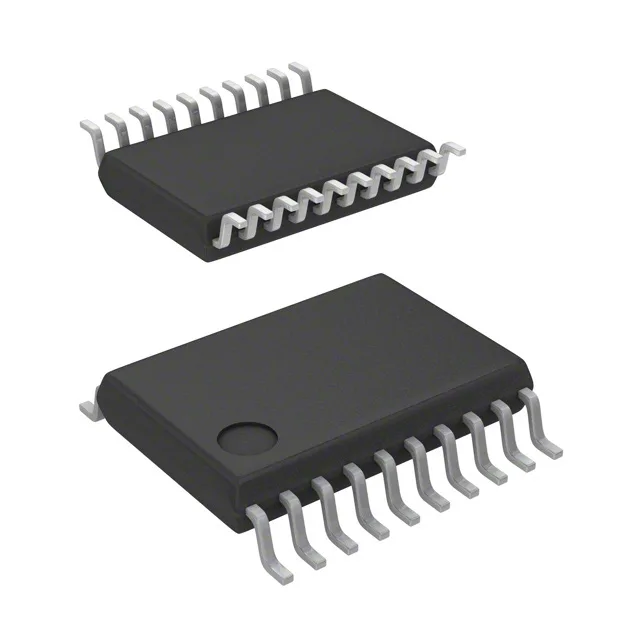
20-LSSOP package, 0.65 mm pitch typical for this body size (4.40 mm width). The 14 general-purpose I/O pins leave six pins for supply, ground, oscillator, and reset — enough for a keypad matrix, a few LEDs, and a serial bus. Surface-mount only; no through-hole variant exists. The 11-channel ADC (8/10-bit selectable) shares pins with the digital I/O — the layout must allocate analog-dedicated pins for sensor inputs that need clean readings. The peripheral set includes DMA, LVD, POR, PWM, and WDT, plus CSI, I²C, and UART/USART connectivity, so external glue logic is minimal.