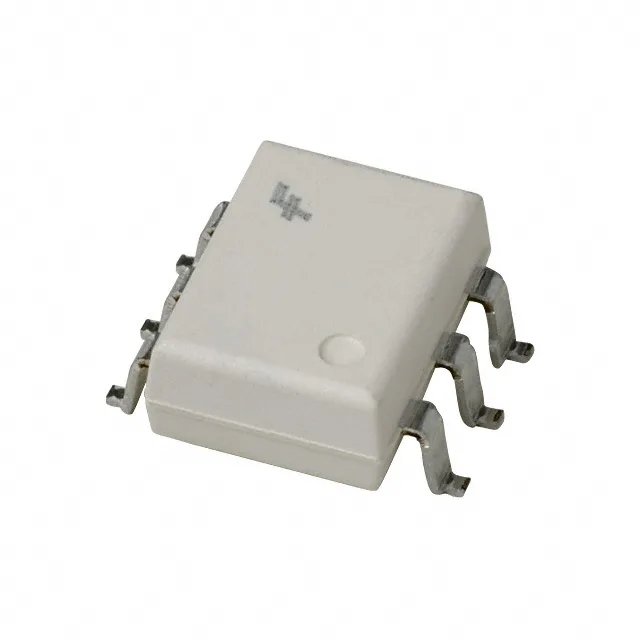
The MOC3081SR2VM is an onsemi optoisolator with a triac output and a built-in zero-crossing circuit, rated for 800 V off-state voltage and 4170 Vrms isolation. The zero-crossing feature means the triac only fires near the AC line zero — switching a resistive load like a heater or incandescent lamp generates minimal inrush and conducted EMI, so the downstream snubber network can be lighter than on a random-phase part. The 600 V/µs minimum static dV/dt rating tells you the triac holds off false turn-on from fast line transients — a relay-coil or motor contactor breaking on the same phase can dump a sharp edge onto the triac without commutating it on. That matters in a panel where inductive loads share the AC bus. The 500 µA typical hold current means the triac latches cleanly at low load currents — a 10 W pilot lamp on a 230 V line draws about 43 mA, well above the hold threshold, so the output stays on until the next zero crossing.
Package and board-fit — 6-SMD gull wing, tape-and-reel ready
Housed in a 6-SMD gull-wing package (supplier device package 6-SMD), the part mounts on the board surface with a 1.27 mm pitch footprint typical of DIP-6 optoisolators. The gull-wing leads give a visual solder-joint inspection point and self-align during reflow — no through-hole staking required. Available on tape-and-reel (TR) or cut tape (CT) — the reel option suits automated pick-and-place for medium-to-high volume builds; cut tape works for prototype or low-volume runs. The 60 mA max LED forward current is generous — a 330 Ω series resistor on a 5 V logic rail keeps the LED current around 12 mA, well under the 15 mA LED trigger threshold, with margin for temperature drift.
Approved under UL, IEC/EN/DIN — the 4170 Vrms isolation rating satisfies reinforced insulation requirements for line-voltage interface circuits. A procurement team can commit this to a BOM line that calls for a UL-recognized optoisolator without a separate qualification cycle.