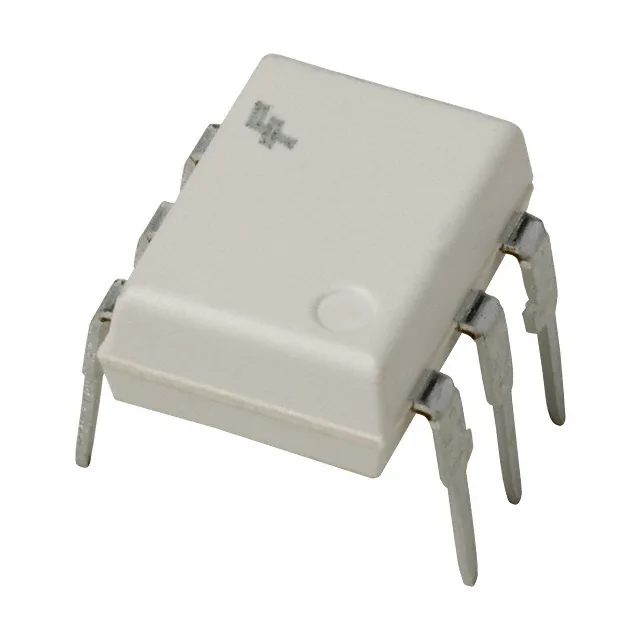
Zero-crossing triac driver for noisy AC loads
The MOC3063VM is a single-channel optoisolator with a triac output and zero-crossing detection, built to switch 600 V off-state loads while keeping the control side galvanically isolated at 4170 Vrms. The zero-crossing circuit turns on the triac only near the AC voltage zero, which limits inrush current into capacitive or cold-filament loads — a common pain point in resistive heater and lamp ballast designs. The 600 V/µs minimum static dV/dt rating means the output triac will not false-fire from fast voltage transients on the mains line, such as those generated by relay contact bounce or nearby motor drives. That margin matters when the load side sees inductive kickback or switching noise.
Trigger current and drive margin
The LED trigger current is 5 mA maximum — a 3.3 V logic output with a 330 Ω series resistor delivers roughly 6 mA into the 1.3 V typical forward drop, comfortably above the threshold. The 60 mA absolute maximum forward current gives headroom for high-temperature derating or long LED life at reduced drive. The 500 µA typical holding current means the internal triac latches on with minimal load current and stays on through the remainder of the half-cycle. For very light loads (below ~5 mA RMS), consider a snubber or a minimum load resistor to prevent dropout at the zero crossing.
Package, compliance, and sourcing
onsemi lists the MOC3063VM as Active and ROHS3 compliant, supplied in a 6-DIP through-hole package on tube. The 0.300-inch body width is a standard DIP footprint — no special layout required beyond the usual 0.100-inch pin spacing. Approved under IEC/EN/DIN and UL, which covers the safety agency requirements for most industrial and appliance designs.