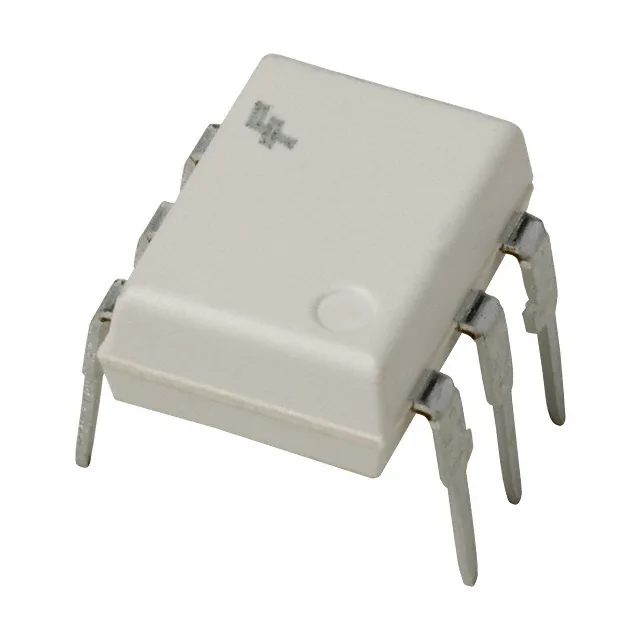
Triac output with zero-crossing — what it means for the load
The MOC3043VM drives a Triac output with a built-in zero-crossing circuit, so the output triggers on only when the AC mains voltage crosses zero — this suppresses the inrush current spike you get when switching resistive or lightly inductive loads at the peak of the sine wave. The 400 V off-state rating means it blocks line voltage up to that peak, suitable for 240 VAC nominal circuits with margin.
Isolation barrier and transient immunity
Rated for 4170 Vrms isolation — this is a reinforced-level test voltage, certified under IEC/EN/DIN and UL. The minimum static dV/dt of 1 kV/µs tells you the output Triac won't falsely trigger on fast voltage transients from the mains side, a common failure in motor-drive or relay-coil circuits without this spec.
Trigger and hold characteristics for the control side
Typical hold current is 400 µA — once triggered, the Triac stays latched until the load current drops below that level, which at the AC zero crossing is the natural commutation point.