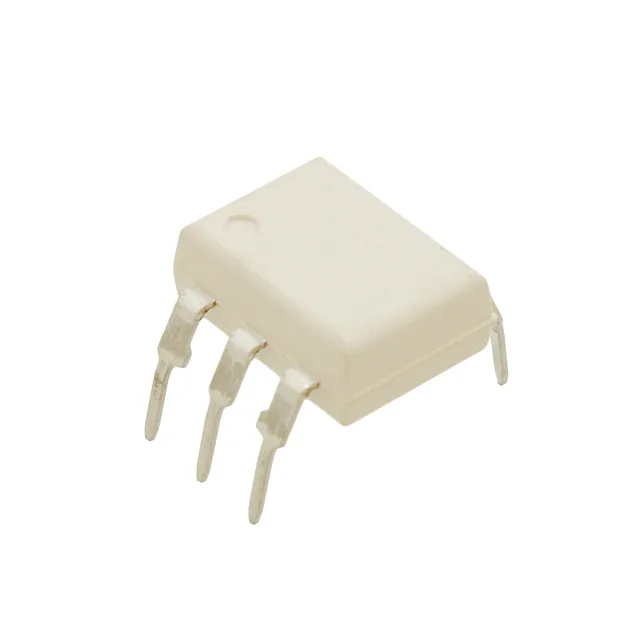
Random-phase triac driver for resistive and inductive loads
The onsemi MOC3020TVM is a 1-channel optoisolator with a triac output, rated for 4170 Vrms isolation between the LED input and the output triac. The off-state output voltage is 400 V, making it suitable for switching 120 VAC or 240 VAC loads through an external triac or SCR. This part has no zero-crossing circuit, which means the output triac triggers immediately when the LED current exceeds the 30 mA maximum LED trigger current (Ift). This random-phase turn-on is needed for phase-control applications like dimmers or soft-starters where the firing angle must be adjustable across the AC cycle.
The 4170 Vrms isolation rating meets reinforced insulation requirements per UL 1577 and IEC/EN/DIN standards, so this opto can be used to separate low-voltage control logic from hazardous mains circuits in a single PCB layout without needing a separate isolation barrier. With a typical holding current (Ih) of 100 µA, the output triac will commutate off cleanly when the load current drops below this threshold near the AC zero crossing. For resistive loads this is straightforward; for inductive loads (motors, solenoids, relays), ensure the load current at turn-off exceeds 100 µA to avoid the triac latching on. The 30 mA maximum trigger current is the threshold the LED must exceed to fire the triac; a 5 V logic rail with a 180 Ω resistor delivers about 21 mA, which is below the trigger threshold — so a transistor buffer or a lower resistor value is needed.
Supplied in tube packaging, the parts are oriented consistently for automatic insertion.
Active lifecycle and compliance documentation
As an active part, it is sourced through authorized distribution channels.