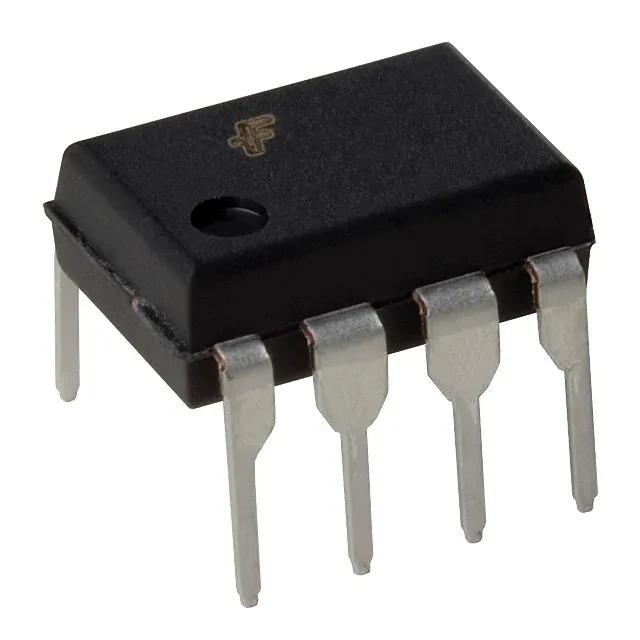
Dual-channel isolation in a through-hole DIP
The onsemi HCPL2531VM is a dual-channel optocoupler with transistor output, packing two isolated channels into a single 8-DIP (0.300", 7.62mm) through-hole package. It delivers 5000Vrms of galvanic isolation between the DC input side and the transistor output side, making it a straightforward choice for breaking ground loops or level-shifting signals in industrial control and power conversion circuits.
The current transfer ratio (CTR) is specified as 19% minimum and 50% maximum at a forward current of 16mA. This means with 16mA through the LED, the output transistor can sink between about 3mA and 8mA (the 8mA per-channel output rating is the absolute ceiling). If your downstream logic input needs 5mA to pull low, you're fine with any unit above a 31% CTR — but a batch at the 19% floor would only deliver 3mA, so budget the minimum CTR into your worst-case pull-up resistor calculation. Turn-on and turn-off times are 250ns and 260ns typical, respectively. That's fast enough for isolating a 1MHz PWM signal or a serial data line running at a few hundred kHz, but not for high-speed communication like 10BASE-T or CAN FD at 5Mbps. The 8-DIP package keeps parasitic capacitance low — the isolation barrier itself is the speed limit, not the lead frame.
Where it fits in a panel or on a board
Through-hole DIP packages are still the go-to for prototyping, rework, and low-volume production where hand-soldering is a reality. The 0.300-inch body width fits standard breadboards and perfboards, and the 7.62mm pin row spacing matches the common DIP footprint. Operating from -40°C to 100°C, it covers most industrial cabinet environments — the 100°C ceiling is the limit for the LED junction, not the epoxy body.