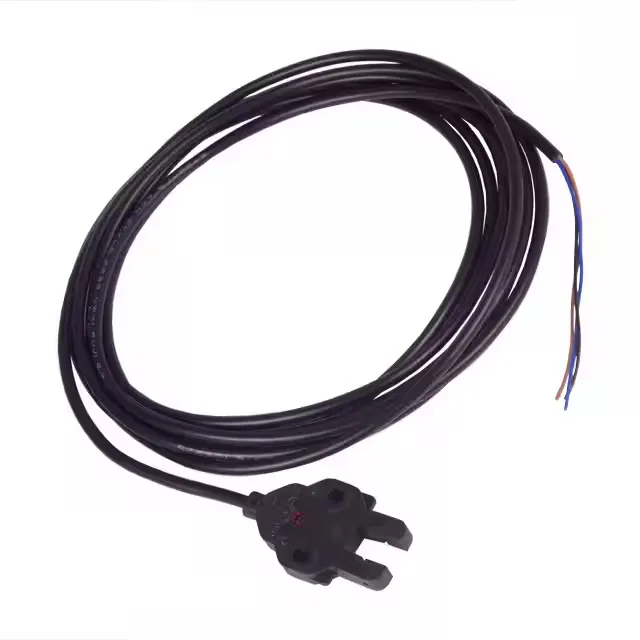
The Omron EE-SX870A is a through-beam photomicrosensor — a U-shaped slot sensor with an emitter and receiver facing each other across a 5 mm gap. When an opaque object breaks the beam, the NPN open-collector output pulls low (Light-ON logic: output is ON when the beam is uninterrupted). It runs on a regulated 5 V supply and switches up to 35 mA, sized for direct connection to a PLC digital input or a logic-level load. The housing mounts with M3 screws to a chassis or bracket, and the wire leads are brought out for termination at a terminal block or connector. Typical deployment is edge detection, position verification, or part-present sensing on small assembly fixtures, pick-and-place feeders, and lab automation where the 5 mm slot matches the part thickness.
5 mm gap — what it means for mounting
The 5 mm sensing distance is the physical slot width. The object passing through must be opaque and thick enough to block the beam — thin films or transparent materials may not trigger reliably. Mounting tolerance matters: the emitter and receiver are fixed inside the slot, so alignment is built-in, but vibration or bracket flex that moves the target out of the beam path causes false triggers. The M3 screw mounting gives a rigid attachment point; use a lock washer or thread-locker if the machine cycles fast.
NPN Light-ON output — wiring and PLC compatibility
Output is NPN open-collector, Light-ON: the transistor sinks current when the beam is uninterrupted, and turns off (high-impedance) when the beam is broken. This mates directly with sinking (NPN) PLC input modules — common on Omron, Mitsubishi, and Keyence controllers. The open-collector output also drives a 5 V relay coil or a logic gate input. Maximum switching current is 35 mA; keep the load current within that limit or use an external transistor to drive higher loads. Pull-up resistor to 5 V is needed if the downstream input expects a voltage signal.
Rated for -25°C to 55°C ambient. That covers most indoor factory and lab environments but not outdoor, freezer, or oven-adjacent locations. The sensor is not sealed against dust or moisture — no IP rating is listed, so keep it inside a control cabinet or away from coolant splash. The -25°C low end is fine for unheated warehouse storage; operation below that risks LED output droop and brittle wire insulation.