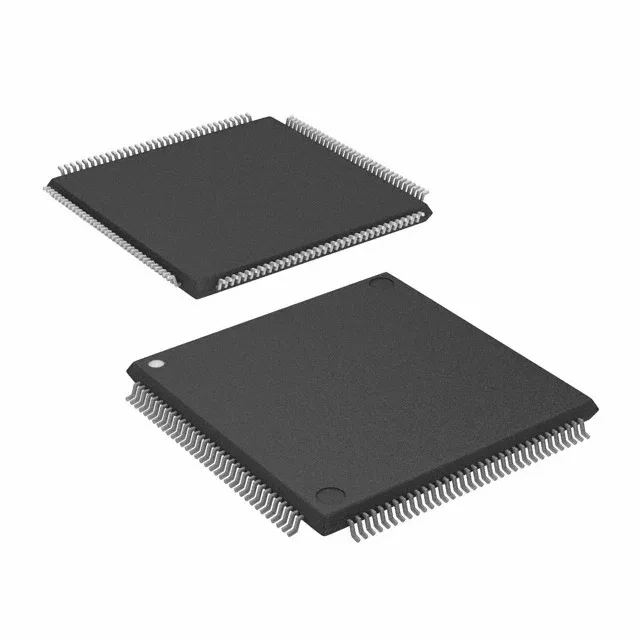
Core specs and what they mean for a control-system BOM
The SPC5604PEF1MLQ6 is a 32-bit single-core MCU from the MPC56xx Qorivva family, built around the e200z0h Power Architecture core clocked at 64 MHz. For a motor-control or body-controller loop, that clock rate delivers deterministic interrupt latency and enough throughput to run a real-time OS with CAN and FlexRay stack overhead. On-chip memory includes 512 KB of Flash for program code, 40K x 8 of SRAM for data and stack, and a separate 64K x 8 EEPROM block for calibration parameters or fault logs that survive power cycles. The EEPROM is a dedicated array, not emulated from Flash, so write endurance and erase time are consistent across the temperature range. With 108 I/O lines and a 30-channel 10-bit ADC, the MCU can directly interface to a mix of digital sensors, switch inputs, and analog signals without external muxing. The ADC sample rate is sufficient for monitoring current-sense resistors or thermistor banks at sub-millisecond intervals.
Automotive network interfaces and temperature grade
Connectivity covers CANbus, FlexRay, LINbus, SPI, and UART/USART — the three automotive buses (CAN, FlexRay, LIN) are what qualify this MCU for chassis-domain or powertrain-interface nodes where deterministic message delivery is required. FlexRay provides the time-triggered slot for safety-critical data; CAN handles the event-driven diagnostics and parameter broadcast.
Package, reflow, and board-level considerations
The exposed pad is on the bottom centre; check the land pattern in the datasheet for the thermal-via array under the pad. Surface-mount only — no through-hole variant. The tray packaging means parts arrive in anti-static trays, not tape-and-reel, so plan for manual or tube-fed pick-and-place if your feeder setup expects 24-mm tape. Tray count per reel is not specified; order in multiples of the tray quantity to avoid partial-tray leftovers.
RoHS3 compliant — no exemptions for lead in solder or cadmium in plating. For compliance documentation beyond RoHS, request the NXP material declaration and PCN history at quote time.