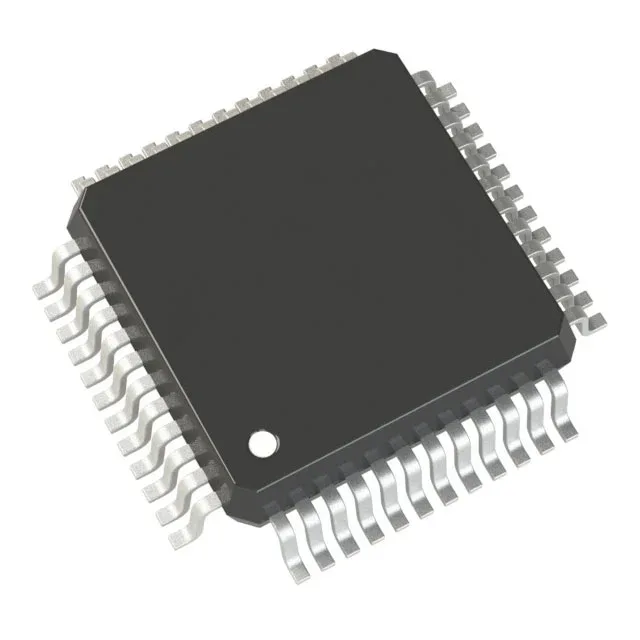
16-bit HCS12 MCU with 48 KB Flash and CAN — the BOM-fit tier for body electronics
The NXP S9S12G48F0CLF is a 16-bit HCS12 microcontroller in a 48-LQFP package, built for cost-sensitive control applications that need deterministic real-time response and a CAN 2.0B interface. The peripheral set includes a 12-channel 10-bit ADC, PWM, watchdog timer, and serial connectivity covering CANbus, LINbus, IrDA, SCI, and SPI — a common combination for automotive body modules, industrial sensor hubs, and motor-control boards where the BOM must stay tight without sacrificing bus compatibility.
The 25 MHz clock rate on the HCS12 core delivers about 12.5 MIPS in typical single-cycle instruction flow. For a CAN node polling a sensor at 1 kHz and updating a PWM output, that leaves enough headroom for a PID loop and a LIN slave stack without pushing the core to its ceiling.
48 KB Flash, 4 KB RAM, 1.5 KB EEPROM — sizing the firmware footprint
The 4 KB RAM is the tighter resource: a 256-byte CAN mailbox buffer and a 1 KB data-logging array leave about 2 KB for stack and variables, which is workable for state-machine-driven code but tight for any heap-heavy library. The 1.5 KB EEPROM is useful for calibration constants and fault codes that must survive a power cycle without external EEPROM.
The low-voltage detect (LVD) and power-on reset (POR) peripherals handle brownout and startup sequencing without an external supervisor IC, saving a few cents and a PCB via.