Supply range — why it matters for your BOM
Accepts two distinct supply ranges: 2.3 V to 3.6 V and 4.5 V to 5.5 V. The I²C bus voltage follows the supply pin.
Housed in a 20-HVQFN (5x5 mm) with an exposed pad.
No last-time-buy notice, no NRND flag.
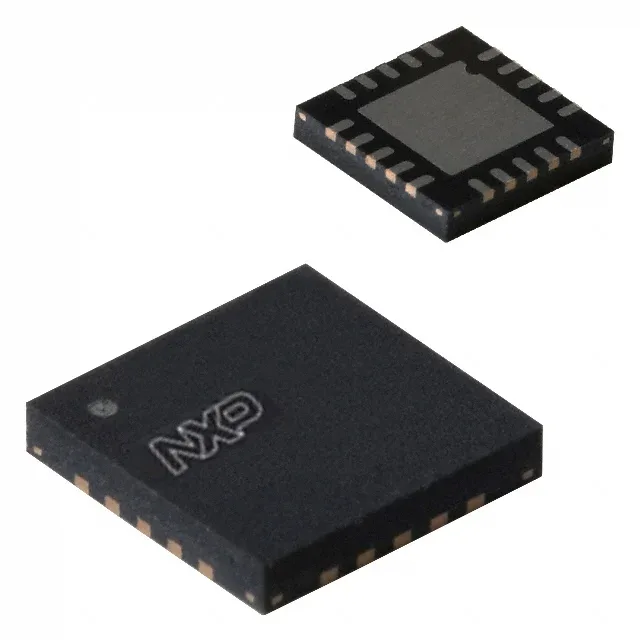
NXP PCA9545ABS,118 4-Channel I²C Switcher, Interface I²C, Dual Supply 2.3V~3.6V / 4.5V~5.5V, 20-HVQFN (5x5), Surface Mount, Active, ROHS3.
| Parameter | Value |
|---|---|
| Mounting | Surface Mount |
| Voltage | 2.3V ~ 3.6V, 4.5V ~ 5.5V |
| Interface | I²C |
| Package | Tape & Reel (TR); Cut Tape (CT) |
| Applications | 4-Channel I²C Switcher |
| Case | 20-VQFN Exposed Pad |
Accepts two distinct supply ranges: 2.3 V to 3.6 V and 4.5 V to 5.5 V. The I²C bus voltage follows the supply pin.
Housed in a 20-HVQFN (5x5 mm) with an exposed pad.
No last-time-buy notice, no NRND flag.
Within the same NXP PCA9545 family, the PCA9545APW (TSSOP-20) and PCA9545AD (SO-20) are functionally identical 4-channel I²C switchers but in different package footprints. The PCA9545ABS,118 uses the 20-HVQFN (5x5) package, so a pin-compatible drop-in would need to share that exact HVQFN footprint — the TSSOP and SOIC variants are not footprint-compatible without a board spin.
It is a 4-channel I²C bus switcher. Use it when multiple I²C slaves share the same address and need to be isolated on separate buses — common in multi-sensor arrays, server management controllers, and mixed-voltage I²C systems where the supply voltage sets the bus logic level.