AEC-Q100 Grade: what the OEM auditor sees
The NTS0102DP-Q100H is an NXP voltage-level translator explicitly qualified to AEC-Q100, the stress-test qualification standard the automotive tier-1s require. This is not an industrial part dressed up as 'automotive-capable' — the Q100 suffix ties it to the full PPAP documentation package an OEM auditor expects.
Bidirectional shifting without a direction pin
Auto-direction sensing means this translator handles bidirectional data flow without a dedicated DIR control pin. The two channels per circuit each sense the data direction from the bus state — a feature that saves a GPIO on the host controller and simplifies the layout for I2C, SMBus, or single-ended serial links. The 50 Mbps data rate is fast enough for most automotive sensor and actuator buses, though a 100BASE-T1 or high-speed CAN FD transceiver interface would need a faster translator.
Supply rails: mapping the logic-level boundary
This dual-rail architecture lets a 1.8 V or 3.3 V MCU domain talk to a 5 V peripheral — a common pattern in automotive mixed-voltage boards where a 3.3 V sensor hub communicates with a 5 V solenoid driver. The open-drain output with tri-state suits wired-AND buses; the pull-up resistors go on the VCCB side for 5 V tolerance.
Lifecycle and sourcing for production programs
The Q100 suffix is the production-grade version of the base NTS0102DP; the non-Q100 variant lacks the AEC-Q100 qualification and the PPAP documentation trail.
Package and mounting for the rework bench
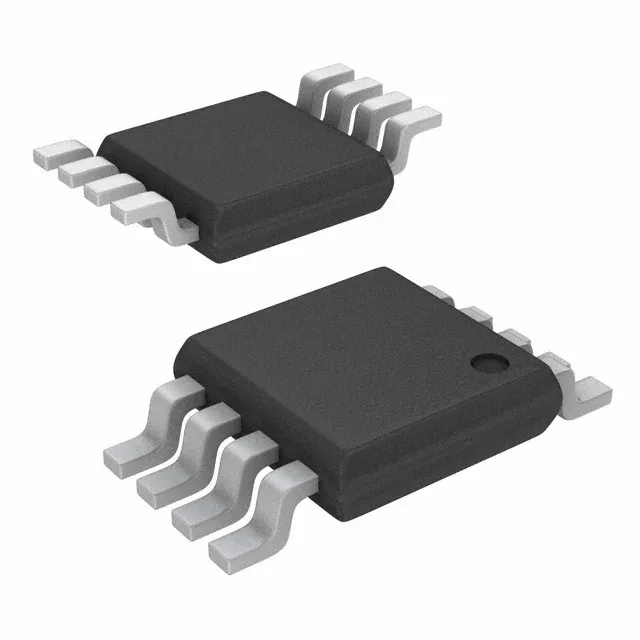
Supplied in an 8-TSSOP package — surface-mount, 3.00 mm body width, 0.65 mm pitch. The small footprint leaves room for the VCCA and VCCB bypass capacitors close to the pins — a 0.1 µF ceramic on each rail directly at the package is the minimum for clean level shifting at 50 Mbps.