Signal level and amplification budget
The MPX2050GP delivers a 40 mV full-scale output when driven from a 10V supply — that is the raw Wheatstone bridge span before any gain stage. A downstream instrumentation amplifier or ADC front-end must provide roughly 50× to 125× gain to bring the signal into the 2–5 V range typical of a microcontroller ADC input. The output is differential with a common-mode voltage at half the supply rail (5 V when Vsup = 10 V). The amplifier's input common-mode range must include this level; a rail-to-rail input stage avoids headroom issues.
Pressure range and overpressure margin
Rated for 7.25 PSI (50 kPa) gauge pressure, with a maximum rated pressure of 29.01 PSI (200 kPa) — a 4× safety margin above the operating point. This allows the sensor to survive pressure spikes common in pneumatic actuator lines and liquid-level sensing without permanent offset shift. The vented-gauge reference means the low-pressure side is open to ambient atmosphere. The sensor reads pressure relative to the local barometric condition, not absolute vacuum. This is the correct type for tank-level or duct-pressure measurements where the reference is atmospheric.
Package, mounting, and thermal range
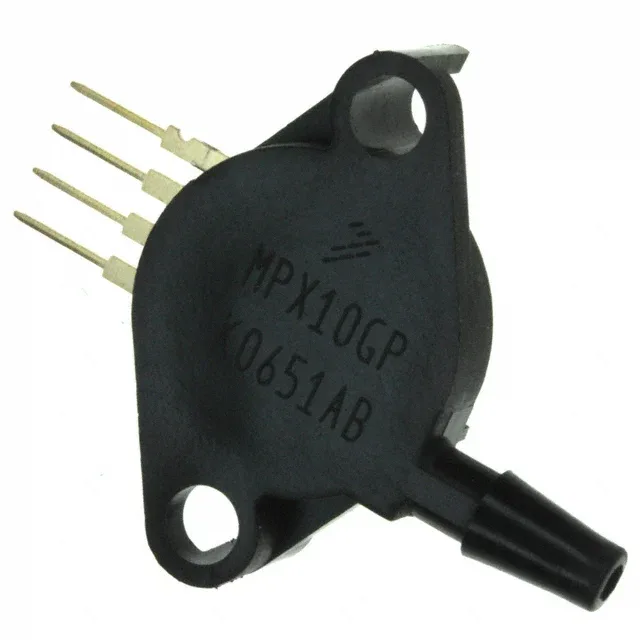
Housed in a 4-SIP (Single In-line Pin) through-hole module with PC pin termination. The four pins are on a 0.100-inch pitch — the PCB footprint is a straightforward row of plated through-holes. No reflow profile is needed; wave or hand soldering applies. The port is a barbed male tube, 0.19-inch (4.93 mm) diameter, designed for push-on flexible tubing. A hose clamp or zip tie on the barb ensures a leak-free seal at the operating pressure. On-chip temperature compensation maintains zero and span stability across this range.
Supply voltage and compliance
Supply voltage range is 10 V to 16 V. The 40 mV full-scale output is specified at 10 V; the span scales ratiometrically with supply voltage, so a regulated supply is recommended to maintain measurement accuracy across the BOM.