ColdFire V1 at 50 MHz — what the core clock buys you
It is built for control-oriented applications — motor drives, industrial sensors, and human-machine interfaces — where the V1 core's instruction-set efficiency and the integrated peripheral set keep the BOM tight. The 50 MHz clock gives you roughly 50 MIPS of sustained throughput, enough to run a field-oriented control loop for a small BLDC motor while the 20-channel 12-bit ADC samples current and position feedback simultaneously.
Memory budget and peripheral fit
For a typical sensor hub or CAN bridge application, that Flash holds the stack, the protocol state machine, and a modest bootloader; the RAM covers FIFOs and a few hundred bytes of variables. The I²C, SCI, and SPI interfaces handle most serial peripherals, and the 54 general-purpose I/O lines give you plenty of headroom for panel buttons, LEDs, and encoder inputs.
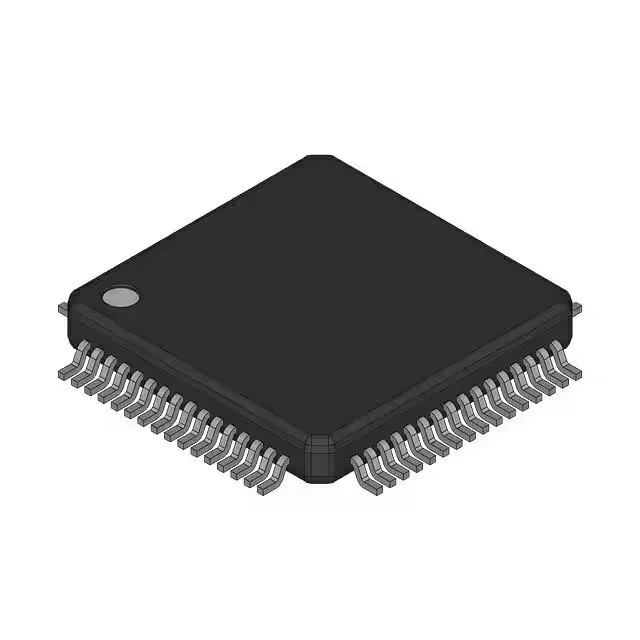
Package and footprint — 64-LQFP
Housed in a 64-pin LQFP with a 10x10 mm body and 0.5 mm pitch. The exposed pad is not present on this package variant, so all thermal dissipation goes through the leads. For a board running at 50 MHz with most I/O switching, keep the copper pour under the package solid and stitch vias to the ground plane. The 54 I/O pins are all 5 V tolerant, which simplifies level translation when interfacing to legacy 5 V logic or sensors.