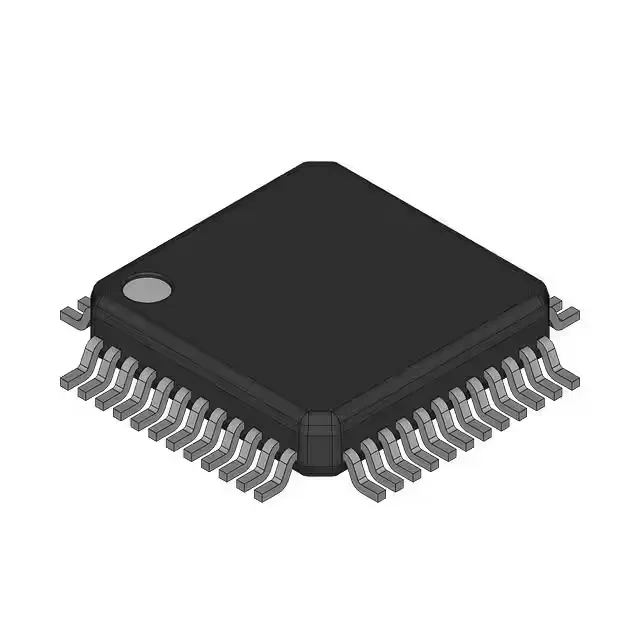
NXP Semiconductors DSP56F801FA80E — Microcontrollers & Processors (MCU / MPU / DSP)

NXP DSP56F801FA80E 16-bit MCU, 80 MHz, 16 KB Flash, 48-LQFP

MPNDSP56F801FA80E
End of Life

NXP Semiconductors 56F8xx series 16-bit Digital Signal Controller, DSP56F801FA80E, 80 MHz, 16 KB Flash, 1K x 16 RAM, 48-LQFP, -40 to 85°C.

$11.82Ref. price · indicative, final on quote
Packaging48-LQFP
Series56F8xx
Sourced new & surplus through independent channelsAuthenticity-screened · ESD-safe packingListing updated Aug 2026

Specifications

DSP56F801FA80E specifications
ParameterValue
Series56F8xx
MountingSurface Mount
Oscillator typeInternal
Program memory typeFLASH
Voltage - supply (Vcc (Vdd))3V ~ 3.6V
Operating temperature-40°C ~ 85°C (TA)
Speed80MHz
PackageBulk
RAM size1K x 16
Core size16-Bit
PeripheralsPOR, PWM, WDT
ConnectivitySCI, SPI
Number of i (O)11
Core processor56800
Case48-LQFP
Data convertersA/D 8x12b
Program memory size16KB (8K x 16)

Product details

80 MHz 56800 core with dedicated motor-control peripherals

The DSP56F801FA80E is a 16-bit digital signal controller from NXP's 56F8xx series, built around the 56800 core and clocked at 80 MHz. The peripheral set is tailored for motor-drive and power-conversion applications: a PWM module with fault inputs, an 8-channel 12-bit ADC for current/voltage sensing, plus SCI and SPI serial interfaces for encoder feedback or host communication. The 11 general-purpose I/O lines handle limit switches, enable signals, and status LEDs without an external GPIO expander.

Package, supply, and temperature grade

Housed in a 48-lead LQFP with a 7x7 mm body (EIAJ standard), the part mounts on a single-sided PCB with 0.5 mm pitch — a four-layer board is typical for the mixed-signal routing.

For production builds that already qualify this order code, the supply chain is stable through authorized distribution channels.

Frequently asked questions

What is the DSP56F801FA80E's core and clock speed?

It uses the 16-bit 56800 core running at 80 MHz. This is the same core architecture as the larger 56F8xx family members, so code ported from a higher-end part like the 56F803 or 56F805 runs with minimal changes — just watch the flash and RAM budget.

How does the DSP56F801FA80E compare to the DSP56F802TA80E?

Both share the same 80 MHz 56800 core, 16 KB flash, and peripheral set (PWM, SCI, SPI, internal oscillator). The key difference is I/O and ADC count: the DSP56F801FA80E gives you 11 GPIO and 8 ADC channels, while the DSP56F802TA80E has 8 GPIO and 5 ADC channels.