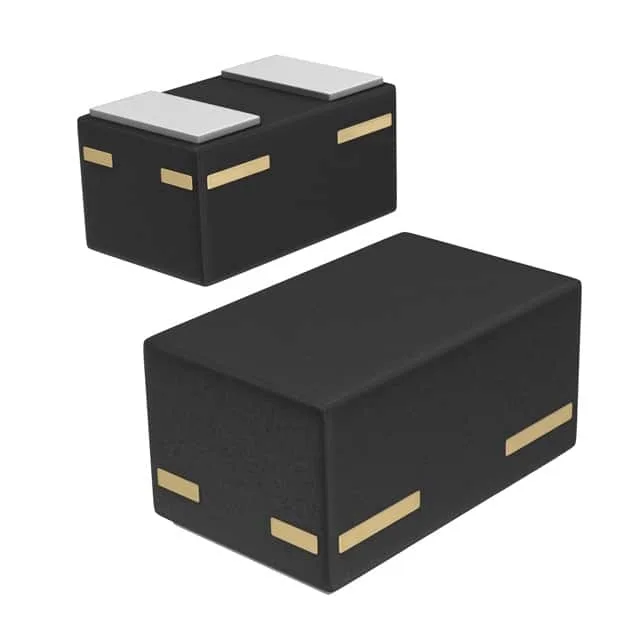
RF PIN diode for switching and attenuator stages
The BAP55LX,315 is a single PIN diode from NXP, designed for RF switching, attenuator, and limiter circuits up to several GHz. Its key parametrics — 0.28 pF capacitance at 20 V and 800 mOhm series resistance at 100 mA — give the designer a clear trade-off between off-state isolation and on-state insertion loss.
Capacitance and resistance: the RF design trade-off
At 20 V reverse bias, the junction capacitance is 0.28 pF (measured at 1 MHz). That low value keeps the diode from coupling RF signal across the junction in the off state, which matters for isolation in T/R switches and shunt attenuators. Forward-biased at 100 mA (100 MHz), the series resistance drops to 800 mOhm. This on-state resistance directly sets the insertion loss through the diode; 800 mOhm is typical for a small-signal PIN diode in a 50-ohm system, adding roughly 0.07 dB loss per series element.
Package footprint and thermal reality
The diode comes in a 2-XDFN package (NXP designation DFN1006D-2), a 1.0 mm × 0.6 mm leadless package with two side-wettable terminations. Maximum power dissipation is 135 mW, so the thermal path relies on the PCB copper pad under the part — no exposed pad, so the solder fillet on the two terminals is the only heat sink.
Temperature range and voltage ceiling
Peak reverse voltage is 50 V, which sets the RF voltage swing limit — for a 50-ohm system, that translates to roughly +34 dBm peak RF power before the diode self-biases into conduction.