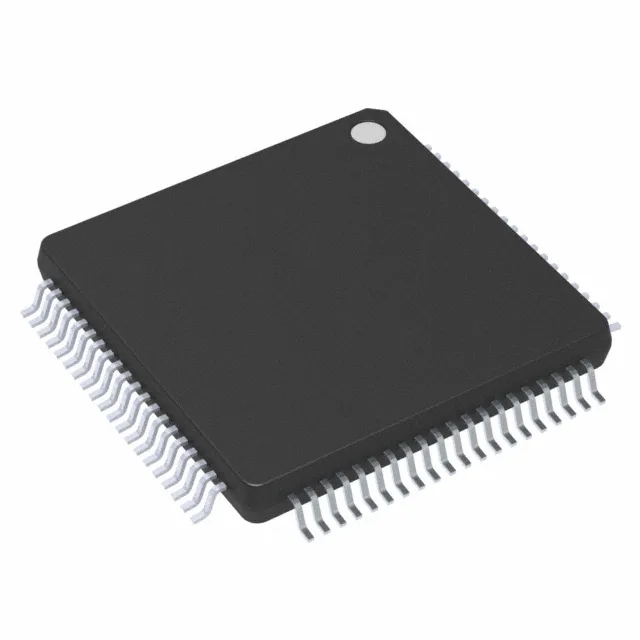
48 MHz Cortex-M0+ — what the speed buys you
The 48 MHz clock on this Cortex-M0+ core is enough for single-cycle GPIO toggling, 12-bit ADC conversions at the listed 16-channel multiplexer, and I²C/SPI/UART communication at typical baud rates. It is not a number-crunching engine — no hardware divider or single-cycle multiply beyond the M0+ baseline — so it fits control and monitoring tasks rather than DSP or heavy math. The 8 KB RAM limits buffering to a few hundred bytes per serial channel; plan firmware around that constraint.
Memory sizing and field updates
64 KB Flash holds a modest firmware image — a bootloader plus application code for a motor drive profile table or a Modbus RTU node. The 8 KB RAM is shared between stack, heap, and ADC data buffers; watch the linker map if you are adding a large protocol stack. Flash is field-reprogrammable via the internal bootloader over UART, so firmware updates are possible without a debug probe.
I/O count and peripheral mix
70 I/O pins in an 80-LQFP give you room for a parallel LCD data bus, a row-column keypad matrix, and several sensor interrupts alongside the serial interfaces (I²C, LINbus, SPI, UART/USART). The 16-channel 12-bit ADC covers analog inputs for current sensing, thermistor readback, or potentiometer feedback. DMA and PWM peripherals offload the core for timed outputs and memory transfers.