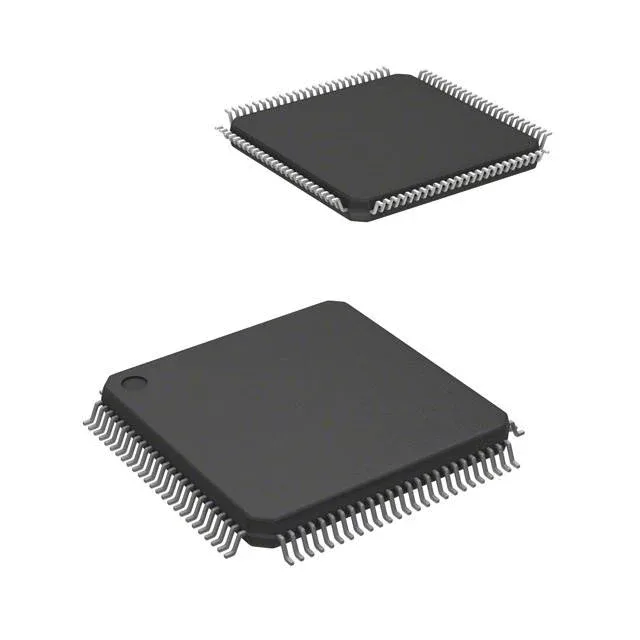
The MK20DX256VLL10 is a 32-bit ARM Cortex-M4 MCU clocked at 100 MHz, with 256 KB of Flash and 64 KB of RAM.
Connectivity and peripherals — what is on the bus
The USB OTG is useful for designs that need to talk to a USB flash drive for data logging or act as a USB device for firmware updates. CANbus is the standard for industrial automation and automotive sub-systems; having it on-chip saves an external CAN controller. The EBI/EMI can connect parallel NOR Flash, SRAM, or an FPGA — useful if the 64 KB internal RAM is tight and you need a frame buffer or co-processor memory. The 33-channel 16-bit ADC covers enough analog inputs for multi-axis sensor arrays or power-monitoring channels. The single 12-bit DAC is there for one analog output — setpoint generation or waveform synthesis, not multi-channel control. On-chip peripherals include DMA, I²S (for audio codec interface), LVD (low-voltage detect), POR (power-on reset), PWM, and a watchdog timer. The DMA engine can move ADC results or serial data without CPU intervention, which helps keep the 100 MHz core free for control math.
The MK20DX256VLL10 comes in a 100-pin LQFP (14x14 mm body) with 66 general-purpose I/O brought out.