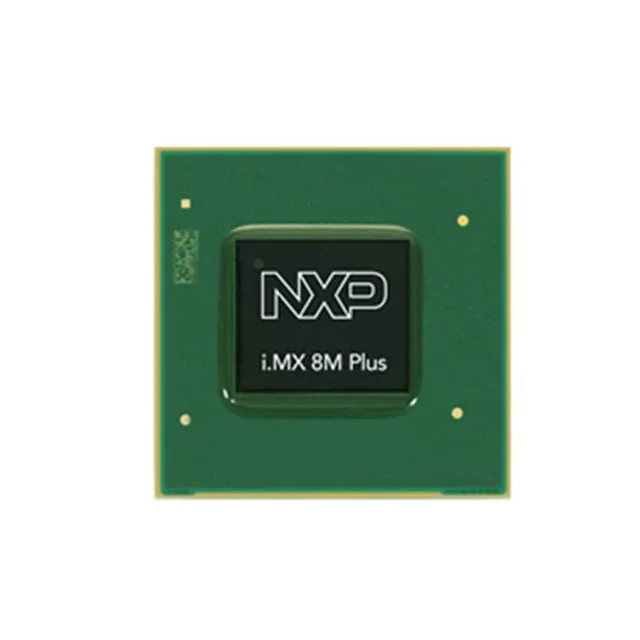
ARM Cortex-M4 coprocessor offloads real-time tasks — motor control loops, sensor fusion, or low-latency I/O — so the Cortex-A53 cores stay free for application software. Memory interface supports DDR3L, DDR4, and LPDDR4 via the integrated RAM controller. That flexibility lets the BOM pick the cheapest or most available DRAM generation without a PCB spin. GbE and dual USB 2.0 with integrated PHY cover the common wired connectivity without external transceivers.
Package and assembly reality
486-LFBGA (14×14 mm) fine-pitch BGA. Needs reflow oven with controlled profile, X-ray inspection, and stencil aligned to the 14×14 mm footprint. Tape-and-reel delivery suits automated pick-and-place for volume builds.
Rated for 0°C to 95°C junction temperature — commercial grade. Covers indoor equipment, office automation, smart appliances, and telecom racks with active cooling.
Security and interfaces
Security features include A-HAB secure boot, ARM TrustZone, CAAM cryptographic accelerator, eFuse for key storage, a random number generator, secure memory, secure RTC, system JTAG control, and SNVS (Secure Non-Volatile Storage). That's the full NXP secure-enclave stack — enough for signed firmware, encrypted storage, and tamper detection without an external secure element. Additional interfaces cover I²C, I²S, eMMC/SDIO, PCIe, SPI, and UART — the standard peripheral set for a Linux-capable SoC. Display and camera interfaces use MIPI-DSI and MIPI-CSI, which connect directly to common display panels and image sensors. Graphics acceleration is on-die, so no separate GPU needed for UI rendering.