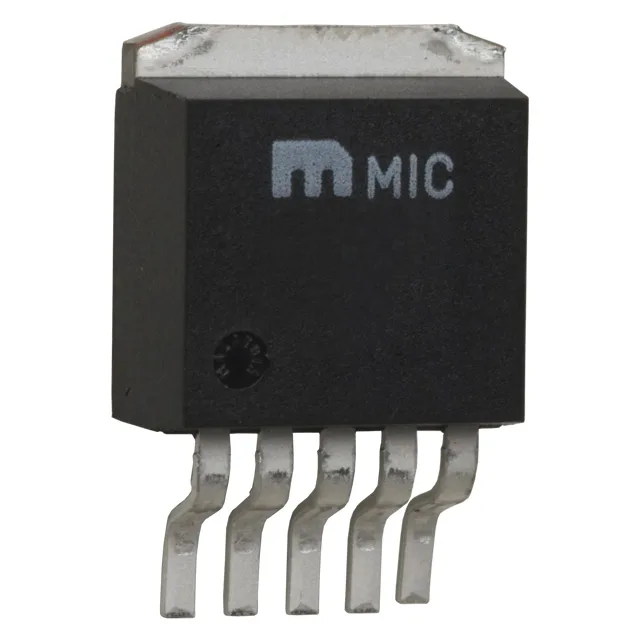
Multi-topology regulator with 2.5 A switch
The MIC2171WU-TR is a 100 kHz switching regulator from Microchip Technology that handles step-up, step-down, and step-up/step-down conversion using buck, boost, Cuk, flyback, or forward converter topologies. Its internal 2.5 A switch delivers enough current for moderate-power rails in industrial control, telecom, or battery-powered systems where a single IC must cover multiple output configurations. The output can be set to any voltage up to 65 V (switch rating), and the topology supports positive or negative outputs with isolation capability.
Package and thermal interface
Housed in a TO-263-5 (D²Pak) surface-mount package with an exposed tab for heat sinking. The tab is the switch node, so the PCB copper area under the tab serves as both thermal path and electrical connection. The 5-lead variant (TO-263BA) matches the standard D²Pak footprint used in many power supply layouts. No synchronous rectifier is integrated, so an external Schottky diode is needed for buck or flyback topologies — the diode's forward drop and recovery time directly affect efficiency at 100 kHz.