Active production — no last-time-buy scramble
Microchip lists the MCP1827S-2502E/AB as Active. ROHS3 compliant, so it clears EU and UKCA markets without an exemption waiver.
Fixed 2.5 V output at 1.5 A continuous. The dropout is 0.6 V max at full load — the input rail needs to stay above 3.1 V worst-case to keep the output in regulation. That headroom is tight if the upstream rail is a 3.3 V switcher with 5% tolerance; budget 3.5 V minimum for margin. Quiescent current is 220 µA — not a micropower LDO, but the 1.5 A capability means the Iq penalty is negligible once the load pulls more than a few mA. The trade-off is better transient response than a lower-Iq part.
PSRR and protection — what the extras mean on the bench
PSRR is 60 dB at 100 Hz — this is the 100/120 Hz ripple from a full-wave rectifier. If the input comes from a linear supply or a poorly filtered DC bus, the LDO knocks that ripple down by 1000×. Above 10 kHz the PSRR rolls off; a ceramic input cap with low ESL preserves the rejection at higher frequencies. Built-in over-temperature shutdown, short-circuit current limit, and under-voltage lockout mean the regulator protects itself without an external crowbar or supervisor IC. The UVLO threshold prevents the pass transistor from operating in the linear region during a slow-rising input, which would otherwise dump excessive power into the die.
TO-220-3 — board-fit and thermal reality
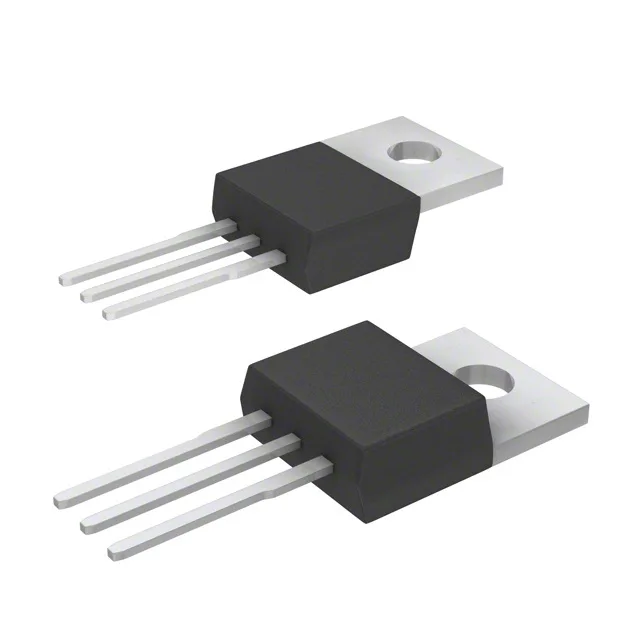
Through-hole TO-220-3. The tab is the output pin — it carries the full 1.5 A and dumps heat into the copper pour or a heatsink. On a 2-layer board with 1 oz copper, the tab soldered to a 1-inch-square pad gives roughly 50°C/W junction-to-ambient; at 1.5 A and 0.6 V dropout the die dissipates 0.9 W, so the junction rises about 45°C above ambient. That leaves headroom to 125°C even in a 70°C enclosure. The part survives cold-crank conditions and sees no derating until the junction exceeds 125°C.