It runs at up to 24 MHz from an internal oscillator, so no external crystal is needed for many timing tasks.
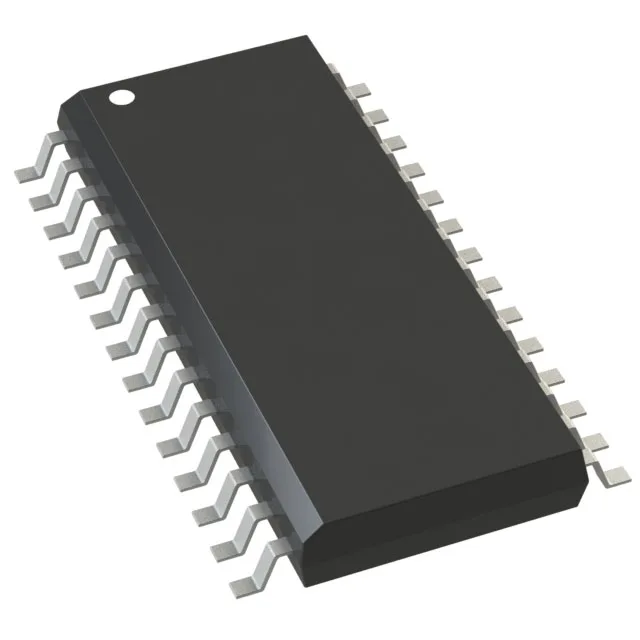
The 28-SOIC package handles the thermal cycling well — the wide-body SOIC (7.50 mm width) has decent heat spreading compared to a narrow SOIC, and the -E suffix parts are typically built on a process that holds parametric stability across the full range.
Memory map and why the EEPROM matters
The 8 KB SRAM handles moderate data buffers; if your application streams ADC readings or holds a large lookup table, check that 8 KB covers your worst-case stack and heap. The 512-byte EEPROM is the part that saves you an external serial EEPROM for calibration constants, node IDs, or fault logs. Because it is true EEPROM (not emulated in Flash), you get the rated endurance without wear-leveling code — useful for counters or parameters that change every power cycle.
On-chip analog: ADC and DAC without external parts
Nine 12-bit ADC channels cover most sensor-input needs — thermistors, potentiometers, current-sense resistors — with enough resolution for 0.1% readings. The single 10-bit DAC can generate an analog reference voltage or drive a simple analog output (like a 0-5 V signal) without an external converter. For designs that need more than one analog output, you will need an external DAC or PWM-plus-filter, but for a single output channel this saves a component and a board trace.
The part is RoHS3 compliant.