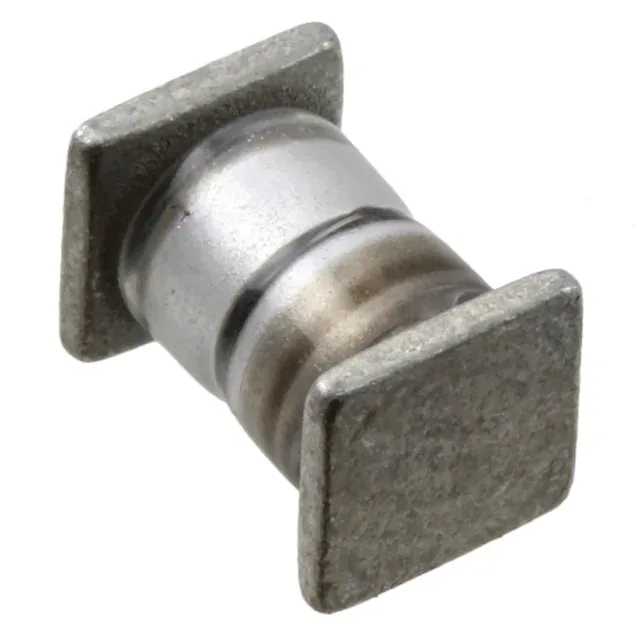
1500 W peak pulse — Zener TVS in SQ-MELF
That 1500 W rating means it can absorb a substantial surge — think lightning-induced transients or inductive load dumps — without failing short. The clamping voltage peaks at 11.2 V at the full 133.9 A peak pulse current, so a 5.7 V rail sees the overvoltage clipped well before it reaches downstream silicon.
7.13 V breakdown — where clamping starts
Breakdown voltage is specified at 7.13 V minimum. That is the threshold where the device transitions from high-impedance to conducting — below that voltage the leakage is negligible, above it the diode shunts current to ground. The reverse standoff voltage is 5.7 V typical, so the part sits on a 5 V or 5.7 V bus without conducting during normal operation. If you are protecting a 5 V logic rail, the margin between 5.7 V standoff and 7.13 V breakdown gives about 1.4 V of headroom before the TVS starts to clamp — enough to ride through mild ripple without nuisance triggering.
Bidirectional — single device protects both polarities
With one bidirectional channel, the 1N6139US clamps equally on positive and negative transients. That simplifies the board layout — one component across the rail and ground, no polarity concern.