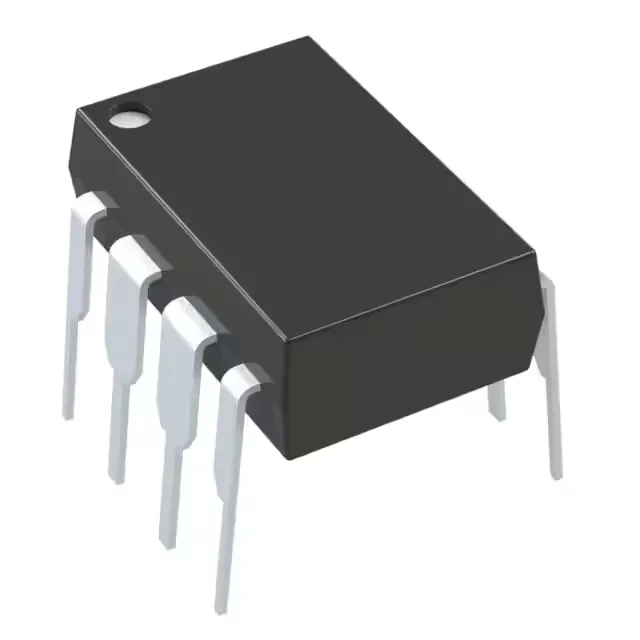
Microchip Technology 11LC080-I/P — Memory (DRAM / SRAM / Flash / EEPROM)

Microchip 11LC080-I/P 8Kbit Single-Wire EEPROM, DIP-8

MPN11LC080-I/P
End of Life

Microchip 11LC080-I/P, 8Kbit EEPROM, Non-Volatile, Single Wire interface, 100 kHz, 2.5V ~ 5.5V, Through Hole, 8-DIP (0.300", 7.62mm), -40°C ~ 85°C.

$0.42Ref. price · indicative, final on quote
Packaging8-DIP (0.300", 7.62mm)
RoHSROHS3 Compliant
Independent supplier — new & surplus stockAuthenticity-screened · ESD-safe packingListing updated Jul 2026

Specifications

11LC080-I/P specifications
ParameterValue
Memory typeNon-Volatile
MountingThrough Hole
Supply voltage2.5V ~ 5.5V
Clock frequency100 kHz
Memory interfaceSingle Wire
Operating temperature-40°C ~ 85°C (TA)
PackageTube
TechnologyEEPROM
Memory size8Kbit
Memory formatEEPROM
Case8-DIP (0.300\", 7.62mm)
Memory organization1K x 8
Write cycle time - word, page5ms

Product details

Single-wire EEPROM for pin-constrained designs

The Microchip 11LC080-I/P is an 8Kbit serial EEPROM that communicates over a single-wire interface, reducing the I/O pin requirement to one data line plus power and ground. Organized as 1K x 8 bits, it operates at a clock frequency of 100 kHz and supports a wide supply range from 2.5V to 5.5V, making it suitable for mixed-voltage systems without level translation. The through-hole 8-DIP package (0.300" width, 7.62mm pitch) is a standard footprint for prototyping and legacy board designs. Typical applications include storing calibration constants, device configuration parameters, and small lookup tables in industrial controls, instrumentation, and consumer electronics where board space is at a premium but a single-wire bus saves a port pin.

Single-wire vs. I²C — the interface trade-off

The 11LC080-I/P uses Microchip's UNI/O single-wire protocol, which requires only one data line plus VDD and VSS. This contrasts with the AT24C08D-PUM, an 8Kbit I²C EEPROM that needs two bus lines (SCL and SDA) plus pull-up resistors. The single-wire interface saves one GPIO on the host microcontroller and simplifies board routing, but the 100 kHz clock of the 11LC080 is slower than the 1 MHz I²C of the AT24C08D-PUM. For applications where speed is secondary to pin count — such as storing a few bytes of configuration data read once at boot — the single-wire trade-off is favorable.

The ROHS3 compliance covers the majority of global regulatory requirements for new designs.

Housed in an 8-DIP (0.300", 7.62mm) through-hole package with a supplier device package of 8-PDIP, the 11LC080-I/P is suited for socketed prototyping, breadboard testing, or designs where vibration resistance is less critical than ease of replacement. The write cycle time of 5 ms per word or page is typical for serial EEPROMs in this density class.

Frequently asked questions

How does the 11LC080-I/P compare to the 24LC080 I²C EEPROM?

The 11LC080 uses a single-wire interface (UNI/O) requiring one data line, while the 24LC080 uses I²C needing two bus lines. The 11LC080 runs at 100 kHz; the 24LC080 can run at up to 1 MHz. For designs where saving a GPIO is more important than bus speed, the single-wire part is the better fit.

Are 11LC080-I/P and 11AA080-I/P interchangeable?

The 11AA080-I/P is the same single-wire EEPROM but with a different supply voltage range (1.8V to 3.6V). The 11LC080-I/P operates from 2.5V to 5.5V. They are not drop-in interchangeable unless the system voltage is within the overlapping range of both parts.

What is the replacement for the 11LC080-I/P if it becomes unavailable?

No official replacement has been announced since the part is Active. For a functional alternative, consider the AT24C08D-PUM (I²C, 8Kbit, 1.7V-5.5V) but note the interface difference — a firmware change to I²C would be required.