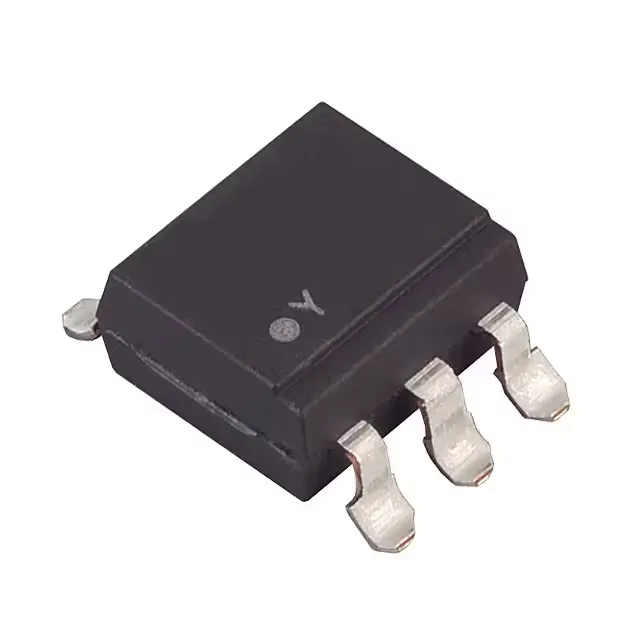
Lite-On Inc. MOC3020S
OPTOISOLATOR 5KV TRIAC 6SMD
Full Technical Specifications
16 Parameters| Parameter / Attribute | Specification / Value |
|---|---|
| Series | MOC302x |
| Output type | Triac |
| Mounting | Surface Mount |
| Voltage - isolation | 5000Vrms |
| Voltage - off state | 400 V |
| Voltage - forward (Vf) | 1.15V |
| Current - hold | 250µA (Typ) |
| Current - DC forward (If) | 50 mA |
| Current - LED trigger (Ift) | 30mA |
| Operating temperature | -40°C ~ 100°C |
| Approval agency | CQC, CSA, TUV, UL, VDE |
| Package | Tube |
| Case | 6-SMD, Gull Wing |
| Channels | 1 |
| Static dV (dt) | 1kV/µs |
| Zero crossing circuit | No |
Need Stock or a Drop-in Second-Source for MOC3020S?
Package: DIP-6 · Pin-compatible replacements with immediate Shenzhen spot stock
The MOC3021 is the little six-pin bridge between logic and mains in dimmers, speed controls, heater regulators and appliance boards: an LED driving a light-triggered triac, packaged with 7500V isolation. The family divides on two axes buyers conflate at their cost. Phase-control circuits (dimmers, motor speed) need the random-phase parts (MOC302x); on/off switching of resistive loads wants the zero-cross parts (MOC304x) so switching happens near the mains zero to tame inrush and EMI. And within each family, only the LED trigger current differs across the ladder (30 / 15 / 10 / 5mA from 3020 to 3023) - a substitution that ignores the trigger grade fails only on cold boards and marginal drive circuits.
Verified Pin-Compatible Replacements (4 verified alternatives)
Same Function, Tighter Trigger
Shenzhen Spot Stock (24-48h Dispatch)
Random-phase optotriac identical to the MOC3021 but triggering at 5mA LED current instead of 15mA - the sensitive end of the ladder (3020 is 30mA, 3022 is 10mA).
400V peak blocking, the 240V-AC class; 7500V isolation common to the family.
The Zero-Cross Sibling - Different Job
Shenzhen Spot Stock (24-48h Dispatch)
The zero-cross version: output inhibits until the mains voltage is near zero (5V typical, 20V max), producing full-wave on/off rather than phase control, with a far higher guaranteed dv/dt (1000V/us minimum) for noisy loads.
400V class; grades 3041/3042/3043 across 15/10/5mA trigger currents.
Random-Phase at 600V
Shenzhen Spot Stock (24-48h Dispatch)
The higher-voltage random-phase member: 600V peak blocking for 380-415V-class lines and noisier mains, with the same phase-control behavior as the 3021.
600V peak against the 400V class of the 302x - the reason it exists.
Zero-Cross at 600V
Shenzhen Spot Stock (24-48h Dispatch)
Zero-cross switching at 600V peak and 5mA trigger - the sensitive end of both ladders at once.
600V class for higher-voltage on/off switching.
Buyer & Quality Checklist for Sourcing Alternatives
- Decide the duty before the part number: phase control (dimmers, speed) takes random-phase (MOC302x / MOC3052); on/off switching takes zero-cross (MOC304x / MOC3063). Mixing the duty and the detector is the most common appliance-board repair mistake.
- Within a family only the trigger current changes: 30mA / 15mA / 10mA / 5mA across the 3020-3023 ladder (and 3041-3043). Substitute toward more sensitivity freely; toward less only with the drive current verified cold.
- Voltage classes: 250V (301x), 400V (302x / 304x), 600V (3052 / 3063). Mains transients decide the class, not the nominal line voltage.
- The optotriac drives a power triac - it never carries the load. In field failures, check the power triac and the snubber network before condemning the coupler: it is usually the messenger.
- dv/dt ratings differ by an order of magnitude between the random-phase and zero-cross families: replacing a zero-cross part with a random-phase one in an inductive-load circuit invites false triggering.
- Gate resistor sizing is per-grade: the resistor that fed 15mA of LED current wastes efficiency with a 5mA part and starves a 30mA part - match the letter to the circuit.
Frequently Asked Technical Questions
Q: Can MOC3041 replace MOC3021?
A: Functionally it triggers and isolates, but the behavior changes: the 3041 is zero-cross, so phase-control circuits (dimmers) lose their firing-angle control and act as on/off switches. Match the family to the duty first; the pinout will agree either way.
Q: What do the numbers after MOC30 mean?
A: The LED trigger current grade: 3020 is 30mA, 3021 15mA, 3022 10mA, 3023 5mA; the 304x zero-cross series repeats the ladder. More-sensitive grades substitute upward; check drive current before substituting downward.
Q: Why does my dimmer only work at full brightness after a repair?
A: A zero-cross part (MOC304x) was likely fitted where a random-phase part (MOC302x) belonged - the zero-cross detector refuses to trigger at low conduction angles. Match the family letter: 302x for phase control.