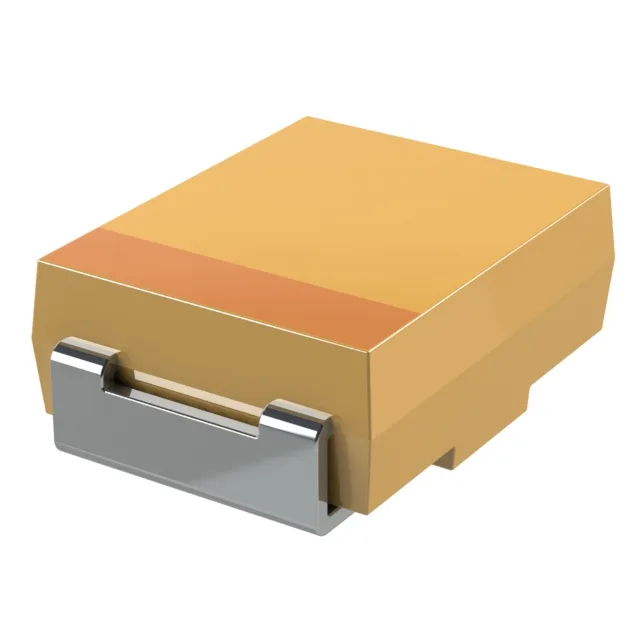
The TPST106K006R1000: The 1 Ω ESR (Equivalent Series Resistance) is the key parameter for ripple handling and power-loss budgeting on a DC rail — a lower ESR means less self-heating and tighter output ripple at the switching frequency. The operating temperature range of -55°C to +125°C covers industrial and automotive ambient conditions without derating at the upper end.
Active production — no EOL watch needed for this BOM line
The molded case construction provides mechanical robustness and a consistent footprint across reflow profiles.
The 1 Ω ESR at 100 kHz is the figure that governs AC ripple current capability. For a 10 µF output cap on a 6.3 V rail, the ripple current rating (derived from the ESR and the capacitor's thermal resistance) determines how much switching noise it can absorb before the internal temperature rise exceeds the 125°C limit. A higher ESR cap would run hotter at the same ripple current. The ±10% tolerance on 10 µF means the actual capacitance at the bias voltage (DC bias derating on tantalum is minimal compared to MLCC) stays within 9 µF to 11 µF across the rated voltage range. This is tight enough for most decoupling and bulk storage applications on a 6.3 V rail.