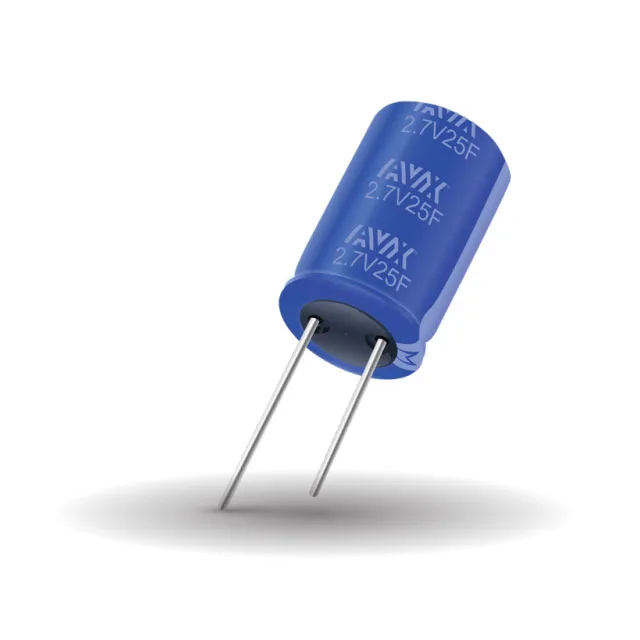
100 F at 2.7 V — energy buffer for backup and peak-power
The SCCV60B107SRBQ is a 100 F supercapacitor from KYOCERA AVX's SCC series, rated at 2.7 V. At this capacitance and voltage, it stores roughly 364 J of energy — enough to hold up a real-time clock or small microcontroller through a brief mains dropout, or to supply a peak-current pulse a battery alone cannot deliver without sagging below the system's brownout threshold. The 15 mOhm ESR at 1 kHz means the internal resistance is low enough that a 10 A pulse draws less than a 150 mV drop across the cell — the capacitor stays above the 2.5 V minimum of most downstream regulators during the surge.
Radial can with 8 mm lead spacing — board-fit reality
Through-hole radial can, 18 mm diameter by 62 mm seated height, with 0.315" (8.00 mm) lead spacing. The leads are PC pins — solder into plated through-holes on a standard 0.1" grid works, but the 8 mm pitch is wider than a typical DIP footprint, so the board layout needs dedicated pads spaced 8 mm centre-to-centre. The -10% / +30% tolerance on the 100 F rating means the actual capacitance can land anywhere from 90 F to 130 F. For a backup-time calculation, budget on the low end (90 F) to guarantee the hold-up time; the high side just adds margin.
65 °C lifetime and temperature range — where it works
Rated for 1000 hours at 65 °C — this is the accelerated life test condition. In practice, at 40 °C the lifetime extends well beyond the rated figure per the Arrhenius acceleration typical for electrolytic-type supercapacitors. The operating range is -40 °C to +65 °C, so it handles outdoor telecom cabinets and industrial enclosures that see cold starts but not engine-bay heat.