Automotive LDO for noise-sensitive rails
The Infineon TLS205B0LDVXUMA1 is an adjustable positive-output LDO from the OPTIREG™ family, delivering 500 mA continuous output with a 65 dB PSRR at 120 Hz. That ripple rejection keeps the downstream rail clean when fed from a switching pre-regulator or a battery line with alternator noise — the 65 dB figure means the output ripple is roughly 0.06% of the input ripple at that frequency, which matters for powering analog sensor front-ends or CAN transceivers in an automotive ECU. An engine control unit or transmission controller that sees 105°C ambient on a hot day still has thermal margin before the LDO enters its over-temperature shutdown.
Dropout, quiescent, and protection
Maximum dropout is 0.45 V at the full 500 mA load. In a 5 V to 3.3 V conversion the headroom is 1.7 V — plenty. In a battery-to-3.3 V rail where the input dips to 4.0 V during cold crank, the dropout headroom shrinks to 0.7 V, still above the 0.45 V ceiling, so the output stays in regulation. Quiescent current is 60 µA typical. For an always-on module in a body controller — a door module or seat ECU that draws 5 mA in sleep — the LDO's own consumption adds 1.2% to the sleep budget, negligible for the battery drain target. Built-in protection covers over-current, over-temperature, and reverse polarity. The reverse polarity clamp means the LDO survives a battery misconnection without an external Schottky in series — one less diode drop in the power path.
PG-TSON-10 package and board integration
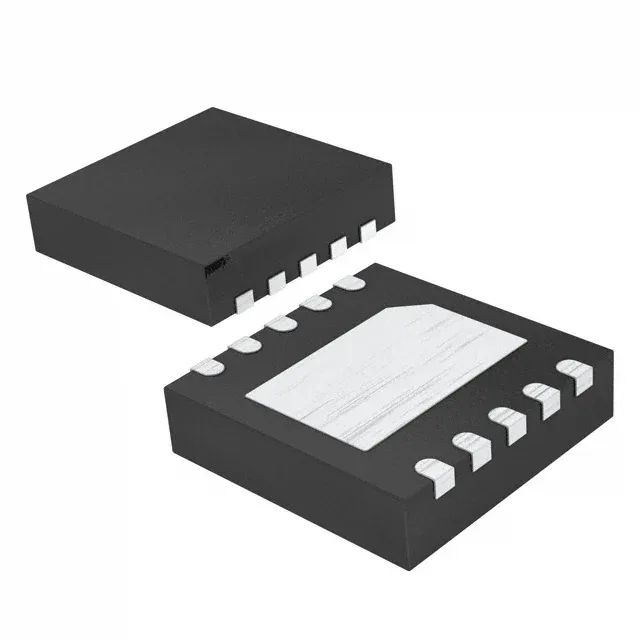
Housed in a 10-lead TFDFN with exposed pad (PG-TSON-10), the thermal path runs through the pad into the PCB copper. The datasheet's RthJA figure assumes a certain pad area — a 4-layer board with thermal vias under the pad pulls the junction temperature down by 20-30°C compared to a 2-layer board with minimal copper. The Enable pin allows the LDO to be gated by a GPIO from the MCU, cutting the 60 µA quiescent draw to near zero in deep-sleep states. Output voltage is adjustable via an external resistor divider from 1.22 V up to 20 V — the same BOM position can serve a 1.8 V MCU core rail or a 5 V sensor supply by swapping two resistors.