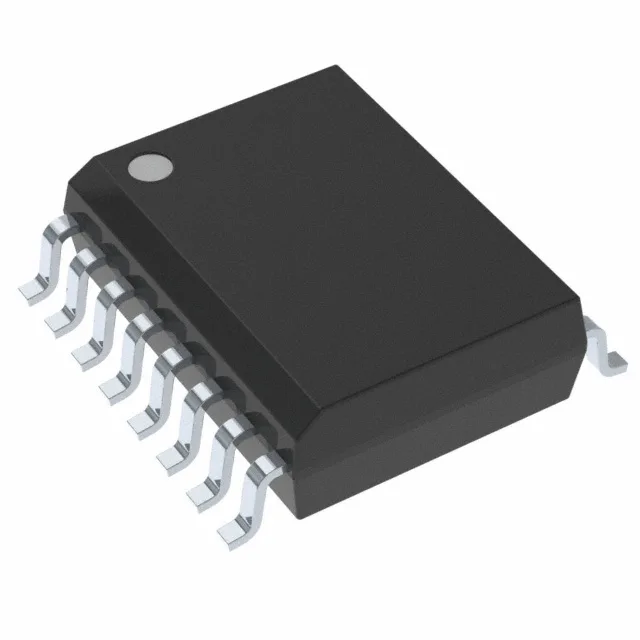
256 Mbit NOR Flash with AEC-Q100 grade for automotive ECU storage
It uses a SPI interface with Quad I/O and QPI support, clocked at 66 MHz. Packaged in a 16-SOIC (7.50 mm width) for surface-mount assembly, it targets automotive applications requiring non-volatile code or data storage under hood or in cabin.
66 MHz clock — read throughput and bus margin
The 66 MHz SPI clock rate sets the maximum read throughput for code shadowing or data logging. At 66 MHz in Quad I/O mode, the effective data rate reaches 33 MB/s (66 MHz × 4 bits per cycle ÷ 8). This is sufficient for most automotive microcontroller boot and firmware-update tasks, but falls short of the 133 MHz variants in the same family (e.g., S25FL256LAGMFM000). If your design requires faster readback for high-resolution display buffers or real-time logging, consider the 133 MHz grade.
105°C operating temperature — under-hood fit check
For engine-bay ECUs mounted directly on the cylinder head or near exhaust manifolds, the 105°C ceiling may be marginal; verify the local ambient temperature at the mounting location. For passenger-cabin, chassis, or body-control modules, 105°C provides adequate margin.
Quad SPI / QPI interface — firmware update bandwidth
The memory supports SPI, Quad I/O, and QPI (Quad Peripheral Interface) protocols. Quad I/O uses four data lines for read/write, doubling throughput over standard SPI. QPI mode further reduces command overhead by sending opcodes over the quad bus. For firmware-over-the-air (FOTA) updates or high-speed code shadowing, the Quad I/O mode at 66 MHz delivers practical throughput around 30 MB/s, limited by command latency and page programming time.