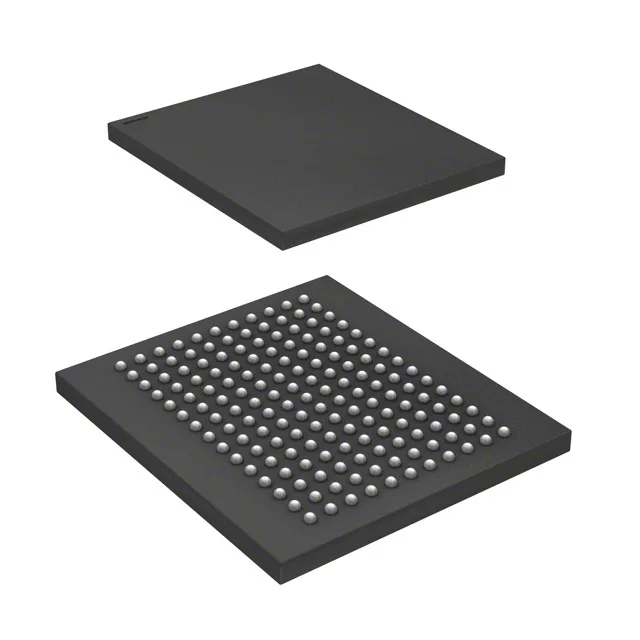
72 Mbit NoBL synchronous SRAM for high-throughput cache and buffer designs
The Infineon CY7C1470V25-200BZXC is a 72 Mbit synchronous pipelined SRAM from the NoBL™ family, organized as 2M x 36 and clocked at 200 MHz with a 3 ns access time.
200 MHz clock and 3 ns access — what they mean for timing closure
At 200 MHz the clock period is 5 ns. With a 3 ns access time from clock edge to data valid, the memory leaves 2 ns of setup margin for the controller's input register — tight but workable with a well-routed board. The NoBL pipeline lets the controller issue a new address every clock cycle without inserting idle cycles on read-to-write or write-to-read turns. For a system that streams data through a 36-bit-wide FIFO or packet buffer, this sustained throughput is the reason to pick this part over a standard synchronous SRAM that stalls on bus-turnaround.
2M x 36 organization — who needs that width
The 2M x 36 arrangement matches processors or ASICs with a 36-bit data bus, which is common in networking ASICs that carry a 32-bit payload plus a 4-bit ECC or tag field. If your controller expects a 32-bit or 18-bit bus, you can use the upper or lower 32 bits and leave the remaining four unconnected, but the 36-bit width is the native word size. The 72 Mbit total density gives 2 million addressable locations, enough for large lookup tables, packet buffers, or trace caches in test equipment.
The supply range is 2.375 V to 2.625 V, so the board needs a dedicated 2.5 V rail. This is tighter than the common 1.8 V or 3.3 V logic levels — if the rest of the system runs at 1.8 V, you will need a separate regulator or a 2.5 V LDO from the 3.3 V input. The 165-FBGA package has multiple VDD and VSS balls; the layout should follow the recommended decoupling pattern in the datasheet to keep supply noise under 100 mV peak-to-peak at 200 MHz switching.
Temperature grade: commercial only — no industrial or automotive variants here
It is not qualified for -40°C cold starts or +85°C enclosures.
The base product number CY7C1470 covers multiple speed and temperature variants, so if the commercial-grade part is on allocation the industrial-grade BZXI variant is a direct drop-in replacement at the same 200 MHz speed grade — just verify the wider temperature range is acceptable for the BOM.