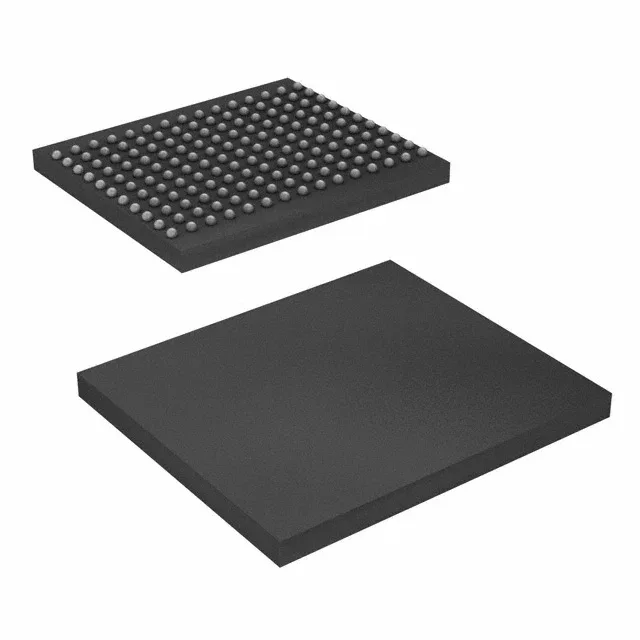
It runs at a 250 MHz clock rate, delivering back-to-back read and write operations on separate ports without dead cycles — the key advantage of the QDR II bus.
At 250 MHz the QDR II interface delivers a data rate of 500 million transfers per second per port (double-data-rate on the clock edges). The 36-bit-wide data bus means each port can move 18 Gbit/s raw. For a design that already has a QDR II controller, this part fits a specific throughput tier — not the fastest QDR II parts (those hit 550 MHz or higher), but a well-established speed grade that keeps timing closure manageable on a four-layer board.
Cypress lists the CY7C1315BV18-250BZC as Obsolete. Any stock you find will be new-old-stock or pulled from cancelled programs. Plan for last-time-buy math: if your annual consumption is low, a one-time buy covering the product's remaining service life may be the cleanest path. If the volume is higher, a pin-compatible QDR II SRAM from a different density or speed grade may require a board spin — there is no drop-in second source cited in the Cypress documentation.
The 165-ball FBGA (13x15 mm) is a fine-pitch BGA with 0.8 mm or 1.0 mm ball pitch — typical for this generation. It is surface-mount only, and the Tray shipping medium means the parts arrive in anti-static trays, not tape-and-reel. For rework, the package is large enough that a hot-air station with a BGA nozzle can handle it, but the board needs a preheat cycle to avoid warping.