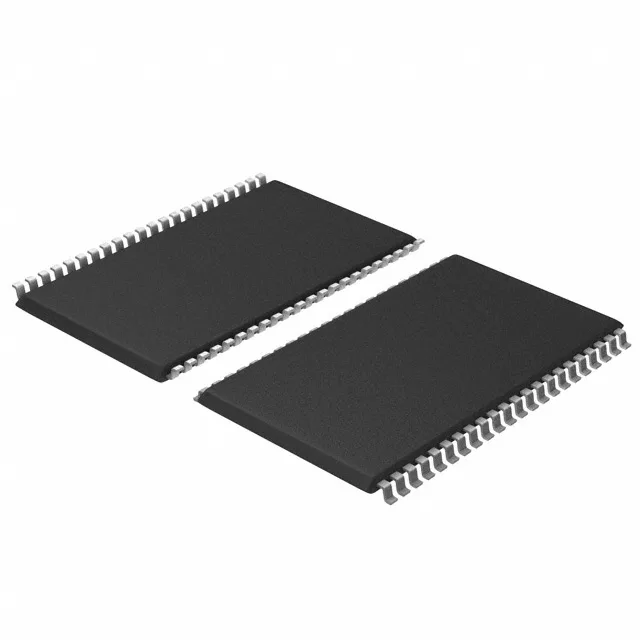
Async SRAM — 4 Mbit, 10 ns, industrial temp
This part is typically used in networking equipment, industrial controllers, and test instrumentation where fast, byte-wide scratchpad or look-up table memory is needed. The 10 ns cycle time keeps bus turnaround tight for processors running at moderate clock rates — no wait states needed on a 50 MHz bus, for example.
The 10 ns access time matches the write cycle time of 10 ns, meaning read and write latencies are symmetric. For a memory-mapped peripheral or a cache tag store, that symmetry simplifies timing closure — you don't need separate margin budgets for read vs write. At 3.3 V nominal the chip delivers this across the full industrial temperature range, not just at 25°C. If your system runs from a 2.2 V rail, expect the access time to stretch; the datasheet's derating curves (not reproduced here) should be checked against your worst-case supply.
Package and assembly
Housed in a 44-TSOP II (0.400", 10.16 mm width) package, surface-mount only. The Tape & Reel (TR) delivery suits automated pick-and-place lines. Standard MSL for this package family is typically 3 — verify the moisture sensitivity level on the reel label before reflow. The 44-TSOP II footprint is shared across several density options in the CY7C1049 family, so a board layout can be reused if a smaller or larger density is needed later.